How to Remove Hard Water Stains From Glass Shower Doors
Most shower door guides skip the one test that tells you whether the marks will come off at all. Here is how to check, the soaking method that actually shifts the deposit, and the thirty-second habit that keeps it clear.
Our shower door went cloudy about four months after we moved in. Not dirty exactly, just permanently hazy, with white spots across the bottom half that came back within a day of cleaning. I sprayed vinegar at it roughly once a week for two months before I worked out that I had been doing the one thing that does not work.
Hard water stains are calcium and magnesium left behind when water evaporates off the glass. The minerals stay, the water goes, and every shower adds another layer. In a hard water area that build-up is visible in weeks.
The good news is that most of it comes off with something you already own. The part almost no guide mentions is that there are two completely different problems that look identical from three feet away, and the fix for one does nothing at all for the other. So that is where this starts.
First, work out what you are actually looking at
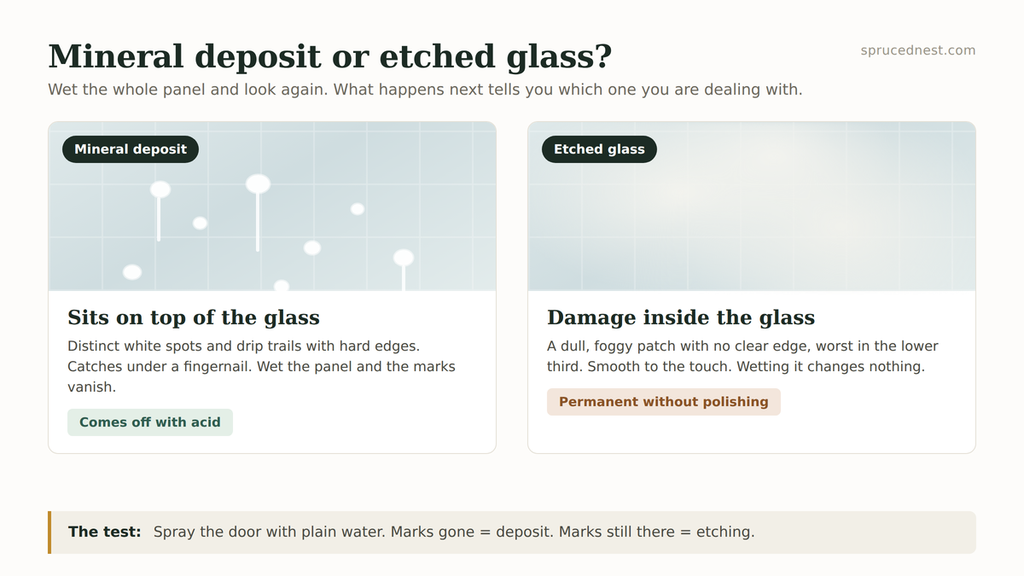
Spray the whole door with plain water and look at it again while it is wet.
If the cloudiness disappears and the glass looks clear, you have mineral deposit sitting on the surface. That comes off. If the panel still looks foggy while soaking wet, the glass itself is etched, and no cleaner is going to fix it.
Mineral deposit
Distinct white spots and drip trails with hard edges. Run a fingernail sideways across a spot and you can feel it catch very slightly. Deposit is usually worst where water sits longest, which on most doors means the bottom 40cm (16 inches) and the strip along the frame.
Etched glass
A dull, even fog with no clear edges, and completely smooth to the touch. This is corrosion. Over years, alkaline minerals and soap residue slowly eat microscopic pits into the surface. Once that has happened the glass scatters light instead of passing it through, which is why it never looks clean no matter what you use.
Most older doors are both. There is usually a layer of removable deposit sitting on top of glass that is already partly etched underneath. Clean it properly and you will get a real improvement, but not back to new. That is worth knowing before you spend a Saturday on it.
Check what your glass is coated with before you start
This step takes two minutes and it is the one that costs people money when they skip it.
A lot of shower enclosures fitted in the last fifteen years have a factory applied protective coating. Common names are ShowerGuard, EnduroShield and Diamon-Fusion. The coating fills in the microscopic texture of the glass so water beads and runs off instead of clinging.
Acids and abrasives strip that coating. Once it is gone, it is gone, and the glass will then stain faster than it did before you cleaned it. If your enclosure is fairly new, check the paperwork or search the manufacturer name plus your model before reaching for vinegar. Coated glass usually needs nothing more than warm water and a soft cloth.
If you have no idea and no paperwork: test on a low corner that sits behind the door hinge, wait a day, and look at it in direct light before doing the whole panel.
In my experience, I found that a standard vinegar spray was not very effective because it ran off the glass too quickly. A more effective method was to soak a paper towel in vinegar and place it directly over the stained areas for about 20–30 minutes. Afterward, I gently wiped the glass with a soft microfiber cloth. For stubborn stains, I had to repeat the process once or twice. The most important lesson I learned was to avoid using abrasive scrubbers, especially when the shower glass has a protective coating.
The vinegar method that actually works
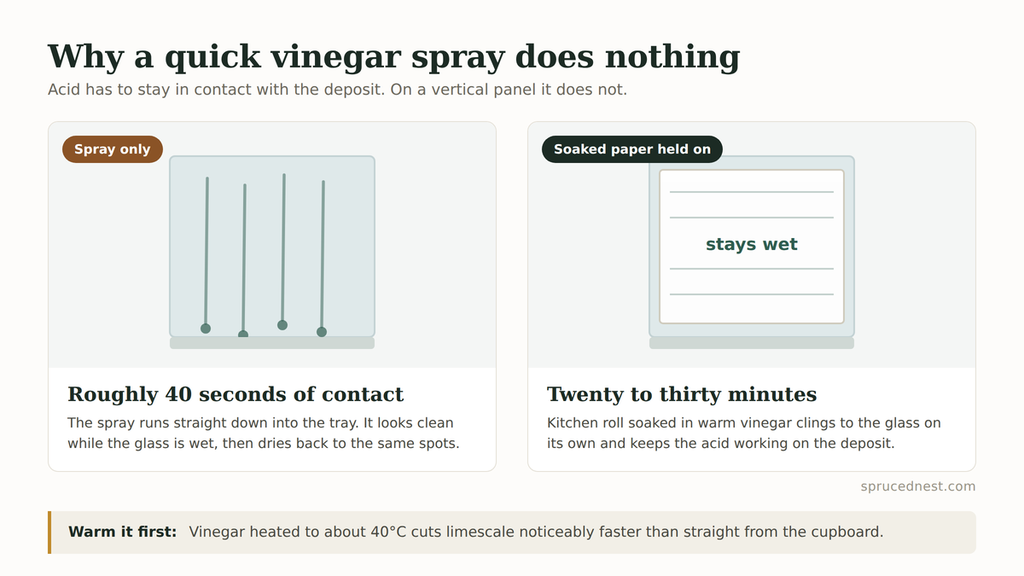
Here is the mistake I made for two months. Vinegar is about 5% acetic acid, and acid dissolves calcium carbonate. That part is fine. The problem is that a spray on a vertical panel drains into the tray in under a minute, and forty seconds of contact does not dissolve anything.
What it needs is twenty to thirty minutes of sustained contact, which means holding the vinegar against the glass rather than spraying it on.
What you need
- White vinegar, roughly 500ml (2 cups). Distilled white is what you want, not malt or cider, which leave their own residue.
- A few drops of washing up liquid
- A roll of kitchen paper, or two old tea towels
- A non-scratch sponge or a plastic scraper
- A squeegee and a microfibre cloth
The washing up liquid matters more than it sounds. Most shower doors have soap scum mixed into the mineral layer, and soap scum is greasy rather than chalky. Vinegar alone slides over it. A surfactant cuts through so the acid can reach the minerals underneath.
Step by step
- Open a window. Warm vinegar in a small bathroom is genuinely unpleasant. Get some airflow going before you start.
- Warm the vinegar. Thirty to forty seconds in the microwave, or stand the jug in hot water. You want it warm to the touch, around 40°C (105°F), not hot. Warm acid works measurably faster than cold.
- Add a few drops of washing up liquid and stir gently. Do not shake it into a foam.
- Soak sheets of kitchen paper and press them onto the glass. Start at the top and work down, overlapping each sheet slightly. Wet paper sticks to vertical glass on its own. Cover every stained area, especially the bottom edge and the strip next to the frame.
- Leave it for 20 to 30 minutes. If sheets start drying out at the top, spray them again. The paper must stay properly wet or the contact time stops counting.
- Peel the paper off and work the glass with the damp sponge, small circles, light pressure. Softened deposit comes away as a faint grit. If you feel resistance, it has not soaked long enough, so re-apply rather than pressing harder.
- Rinse thoroughly with clean water. Leftover vinegar attracts new deposit and will haze the glass again as it dries.
- Squeegee, then dry with microfibre. Do not let it air dry, or you have just made fresh water spots on a door you spent an hour cleaning.
If the deposit is thick
For build-up you can feel clearly with a fingertip, one soak will not clear it. Do the soak, wipe, then make a paste of bicarbonate of soda (baking soda) and a little water, and work that over the remaining patches with the sponge.
Bicarb is a very mild abrasive, soft enough that it will not scratch glass but hard enough to shift softened scale. Do it after the acid, never mixed with it. Mixing the two just gives you fizzing salt water and neither ingredient does its job.
Ours took three soak-and-wipe rounds across one afternoon to clear properly. Round one looked like barely any progress, which is where most people give up.
When vinegar is not enough
In very hard water areas, or on a door that has gone untouched for years, household vinegar sometimes will not get there. These are the stronger options, roughly in order of how careful you need to be.
| Product | Active ingredient | Good for | Watch out for |
|---|---|---|---|
| Citric acid powder | Citric acid | Stronger than vinegar, much less smell | Mix fresh, dissolves slowly in cold water |
| Bar Keepers Friend | Oxalic acid, mild abrasive | Thick scale and cloudy patches | Never on coated glass. Test a corner first |
| Viakal (UK), CLR or Lime-A-Way (US) | Formic or lactic acid blends | Heavy limescale, fast acting | Strict dwell times. Do not leave to dry on |
| Cerium oxide polish | Abrasive polishing compound | Light etching only | Slow, needs a drill and patience |
Whatever you use, follow the dwell time on the label rather than guessing, keep it off any natural stone, and rinse properly afterwards.
Stone thresholds: if the strip under your shower door is marble, travertine or limestone, keep every acid off it completely. Acid etches stone within seconds and leaves a dull mark that is far harder to fix than the glass ever was. Lay a dry towel along the bottom before you start.
Things we tried that did not work
Glass cleaner. Blue spray glass cleaner is designed for dust and fingerprints. It has no acid in it and does nothing whatsoever to mineral deposit. It made the door look better for about ten minutes while it was wet.
A magic eraser. Melamine foam is more abrasive than people realise. It took off some deposit and left a patch of fine scratching that catches the light at exactly the angle you notice from the doorway. I would not use one on glass again.
Lemon juice. Weaker than vinegar, stickier, and it leaves sugars behind that need rinsing off. It is fine on a tap. It is not up to a whole shower panel.
A razor blade. This one does work on uncoated glass if you keep the blade at a very shallow angle and keep the surface soaking wet throughout. But the margin for error is small, a dry blade will scratch, and it is useless on coated glass. Given that soaking achieves the same thing with no risk, I would skip it.
[My Experience] — I also tried baking soda as a quick fix. I made a paste and gently rubbed it onto a small section of the glass. While it removed some surface grime, it didn’t make much of a difference on the old, hazy, hard water stains. The process also took longer than I expected, so I wouldn’t make it my first choice for the entire shower door.
Two mixtures to never make
Vinegar or any acid with bleach. This produces chlorine gas. In a small, closed bathroom that is a genuine emergency, not an inconvenience. If you have used a bleach based cleaner in the shower, rinse everything thoroughly and ventilate the room before you bring any acid in.
Vinegar with hydrogen peroxide in the same bottle. Combined, they form peracetic acid, which is corrosive and irritating to skin, eyes and airways. Used one after the other with a rinse in between is fine. Mixed in a spray bottle is not.
As a general rule, use one cleaning product at a time and rinse between them.
Keeping it off, which matters more than the cleaning
Hard water stains form because water is allowed to dry on glass. Every prevention method is a version of not letting that happen.
| Method | Effort | How well it holds up |
|---|---|---|
| Squeegee after every shower | 30 seconds | Easily the most effective single change |
| Leave the door open, run the fan | None | Helps, but not enough on its own |
| Rinse aid wiped on the glass | 5 minutes, fortnightly | Water sheets off instead of beading |
| Daily shower spray | 10 seconds | Slows build-up, does not stop it |
| Water softener | Installation cost | Fixes the cause, not just the symptom |
If you only do one of these, make it the squeegee, and keep it hanging inside the enclosure where you cannot avoid seeing it. Ours lives on a suction hook on the inside of the door. Stored in the cupboard under the sink, it got used for about four days.
The rinse aid trick is worth trying if you have not heard of it. A small amount of dishwasher rinse aid on a damp cloth, wiped thinly over clean dry glass and buffed off, makes water sheet down the panel instead of sitting in droplets. Fewer droplets means fewer places for minerals to dry. It wears off after a week or two, so it is a top-up job rather than a permanent fix.
If the glass is already etched
There is no cleaner that reverses etching, and anything sold as though it does is either an acid that will remove the deposit sitting on top, or a filler that lasts until the next few showers.
Three real options:
- Polish it out yourself with cerium oxide and a felt pad on a drill. Slow, messy, and only realistic for light etching, but it does work if you are patient and keep the glass wet throughout.
- Get it professionally restored. Glass restoration companies do this properly. Usually cheaper than replacement and worth a quote before you write the panel off.
- Replace the panel and apply a protective coating to the new glass straight away, before it has ever been used.
Whichever route you take, sort out the prevention routine first. There is no point restoring glass and then going straight back to letting hard water dry on it.
Common questions
How long should vinegar sit on shower glass?
Twenty to thirty minutes, kept continuously wet. Anything under ten minutes is not really doing anything, and leaving it on for hours brings no extra benefit once the paper has dried out.
Will vinegar damage shower door seals?
Occasional contact is fine. Repeated soaking will make rubber seals harden and crack over time, so keep the vinegar on the glass and rinse the seals well afterwards.
Is it safe on framed enclosures?
Anodised aluminium frames tolerate short contact but can dull if acid is left to dry on them. Chrome plating is more sensitive again. Wipe any overspill off the frame as you go rather than letting it sit.
How often does this need doing?
With a daily squeegee, a proper deep clean once or twice a year. Without one, expect visible spotting again within a month in a hard water area.
The short version
Wet the glass and look at it to find out whether you have deposit or etching. Check for a protective coating before you put acid anywhere near it. Then soak rather than spray, warm vinegar on kitchen paper, twenty to thirty minutes, wipe, rinse, dry.
And then hang a squeegee inside the door, because thirty seconds after each shower is the difference between doing this twice a year and doing it every month.
[MY EXPERIENCE] — After cleaning the door this way, the glass looked noticeably clearer and most of the white buildup was gone. The biggest improvement came from giving the vinegar enough time to work instead of spraying and wiping it immediately. If I were doing it again, I would start cleaning the stains earlier and use a squeegee after each shower to prevent the buildup from returning.
Hi, this is a comment.
To get started with moderating, editing, and deleting comments, please visit the Comments screen in the dashboard.
Commenter avatars come from Gravatar.