Where to Store Food in Your Fridge, Shelf by Shelf
A shelf-by-shelf map of where to store food in your fridge, from the warm door to the cold bottom shelf, plus the foods that should never go in at all.

Quick answer: Knowing where to store food in your fridge comes down to temperature zones. Raw meat goes on the bottom shelf, dairy and eggs in the middle, leftovers on top, produce in the crisper drawers, and only condiments and drinks in the door.
That’s the short version. The longer version explains why the milk you keep in the door spoils early, why a packed fridge keeps food worse, and which foods shouldn’t be in there at all.
A fridge isn’t one temperature. Cold air sinks, so the bottom runs colder than the top. Meanwhile, the door is the warmest spot of all, because it swings into a warm kitchen every time someone opens it. Once you know that, every rule below makes sense.
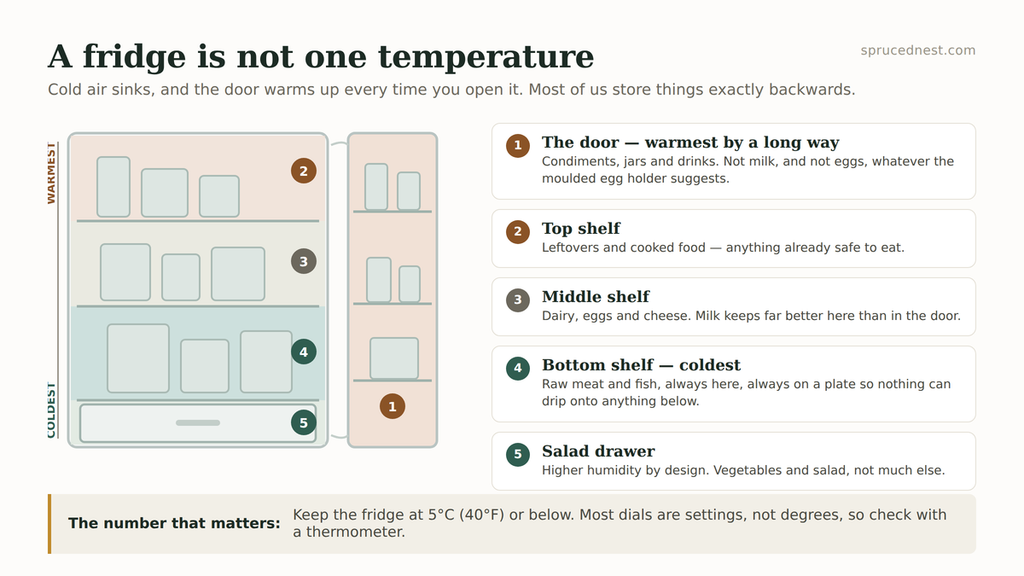
Before you start moving things, check the actual temperature. The dial inside most fridges is a power setting, not a reading. A food storage guide from the FDA says to keep the refrigerator at or below 40°F (4°C), and recommends an appliance thermometer to check. Leave one on the middle shelf overnight, then adjust the dial from there.
Zone 1: The door (warmest)
Put here: condiments, jams, sauces, pickles, butter, and drinks.
The door shelves are the least insulated part of the fridge, and their temperature swings every time you open it. That’s fine for foods preserved with sugar, salt, vinegar or acid, which cope well with small changes. Butter is fine in a covered door compartment, too, as long as you use it within a few weeks.
Don’t put here: milk or eggs. It seems odd, given the built-in egg tray and bottle rack. Even so, the FDA advises storing eggs in their carton inside the fridge rather than in the door. Moving the milk to a shelf takes ten seconds, and it’s the single change most likely to stop it from turning early.
Zone 2: The top shelf, where to store food that’s ready to eat
Put here: leftovers, cooked food, deli items, and anything ready to eat.
The top shelf sits above all the raw food, so nothing can drip onto it. It’s a little warmer than the lower shelves, which suits food you’ll eat soon. Keep leftovers in clear, lidded containers so you can see what needs finishing first.
Not sure where to store food that fits no obvious zone, like half a can of beans? Move it into a lidded container and put it on the top shelf. Food left in an opened can can pick up a metallic taste.
Got a pot of soup or chili? Let it cool slightly, but don’t leave it out too long. The FDA says perishable food shouldn’t sit at room temperature for more than two hours. Splitting a big batch into shallow containers helps it cool quickly.
Zone 3: The middle shelves, where to store food from the dairy aisle
Put here: milk, eggs in their carton, cheese, yogurt, and other dairy.
The middle of the fridge is steady and properly cold, unlike the door. That’s why it’s the best place for dairy and eggs. Keep eggs in their original box, too, because it stops them from absorbing other smells.
This is also where your thermometer belongs. If the middle shelf reads 40°F or below, the rest of the fridge is usually in a safe range.
Zone 4: The bottom shelf (coldest)
Put here: raw meat, poultry and fish, always on a plate or in a sealed container.
If you only learn one rule about where to store food in the fridge, make it this one. The bottom shelf is the coldest spot, and there’s nothing underneath for juices to drip onto. Store packaging tends to drip, so give raw meat its own sealed box or a lidded tray.
Thawing meat belongs here as well. Put it on a rimmed plate the night before you need it.
Zone 5: The crisper drawers
Put here: vegetables, salad greens, and fruit, ideally split between two drawers.
Crisper drawers hold higher humidity than the rest of the fridge. Many have a small slider that changes it:
- High humidity (vents closed) suits leafy greens, herbs, carrots and other things that wilt.
- Low humidity (vents open) suits fruit that tends to rot, such as apples and pears.
Keep ethylene producers apart
Some fruit releases ethylene gas as it ripens. That gas speeds up ripening, and then spoilage, in nearby produce. So a bag of salad next to apples goes limp in half the time.
| Gives off ethylene | Sensitive to it |
|---|---|
| Apples, pears | Leafy greens and lettuce |
| Avocados, peaches, plums | Broccoli and cabbage |
| Ripe tomatoes, melons | Carrots and cucumbers |
If you have two drawers, give fruit one and vegetables the other. Also, move salad out of its sealed bag and into a box lined with a paper towel. That absorbs moisture and keeps leaves crisp for longer.
Zone 6: Where to store food that hates the cold
Part of knowing where to store food is knowing what stays out. Cold isn’t always better:
- Potatoes: cold turns some of the starch to sugar, changing the taste and how they brown. Keep them in a cool, dark pantry.
- Onions and garlic: they turn soft and moldy in fridge humidity. Store them somewhere dry and airy, away from potatoes.
- Whole tomatoes: cold dulls their flavor and makes them mealy, so keep them on the counter.
- Bread: it goes stale faster in the fridge. Freeze it instead if you can’t finish it.
- Bananas and unripe fruit: bananas blacken, and other fruit stops ripening.
- Honey: it crystallizes and gets hard to pour.
Once any of these are cut or cooked, though, the rules change. A whole tomato belongs on the counter. Half a tomato goes in the fridge.
Fruit flies can be a sign that produce has been left out too long. If they appear, here’s how to get rid of fruit flies in the kitchen.
Why a packed fridge keeps food worse

A fridge cools by moving air, usually from a vent at the back. Cold air flows out, falls, travels across the shelves and returns. When shelves are crammed full, air can’t get through. As a result, warm pockets form in the middle, even if the thermometer near the front looks fine.
- Leave gaps. An inch between items and a clear strip at the back is plenty.
- Keep the vent clear. Pushing a big tub against it blocks airflow for the whole shelf.
- Skip shelf liners. Foil or plastic over a wire shelf stops air from moving up and down.
A freezer is the opposite. Frozen food holds cold, so a full freezer stays cold longer after you open it. That trick just doesn’t work for the fridge.
Habits that shorten food’s life
- Standing with the door open. Decide what you want before you open it.
- Putting very hot food straight in. A steaming dish warms everything around it, so cool it briefly first and refrigerate it within two hours.
- Ignoring the door seal. Close the door on a sheet of paper and pull. If it slides out easily, the seal needs replacing.
- Forgetting the coils. Dusty condenser coils make the fridge work harder. Unplug it and vacuum them once or twice a year.
- Letting spills sit. Wipe them right away with warm soapy water. Skip bleach and strong scents, because plastic absorbs smells. An open box of baking soda helps with general odors.
Keeping cupboards in order helps too. These tips to organize kitchen cupboards pair well with a tidy fridge.
Where to store food: the summary table
| Zone | Temperature | Store here | Keep out |
|---|---|---|---|
| Door | Warmest, most variable | Condiments, jams, pickles, butter, drinks | Milk, eggs, raw meat |
| Top shelf | Cold | Leftovers, cooked and ready-to-eat food | Raw meat |
| Middle shelves | Steady and cold | Milk, eggs in the carton, cheese, yogurt | Anything that could drip |
| Bottom shelf | Coldest | Raw meat, poultry, fish on a plate | Ready-to-eat food |
| Crisper drawers | Cold and humid | Vegetables, greens, fruit in separate drawers | Ethylene fruit next to greens |
| Pantry or counter | Room temperature | Potatoes, onions, garlic, whole tomatoes, bread, bananas, honey | Cut or cooked versions of these |
Print it, stick it on the fridge, and spend five minutes moving things tonight. Your milk, your salad and your grocery budget will all last longer.

One comment