Small Entryway Storage: What Actually Fits in a Narrow Hallway
Small entryway storage ideas grouped by how wide your hallway really is, so you only look at the hooks, shelves and benches that will fit.
Small entryway storage only works if it fits the space you actually have, not the wide, sunlit foyer in the photo. Say your hallway is 90cm (about 35 inches) wide. A standard 40cm-deep shoe cabinet would eat almost half of it, and you’d be turning sideways every time you came home.
So this list is sorted by width. Measure first, find your section, and skip the ideas that were never going to fit.
Measure before you buy small entryway storage
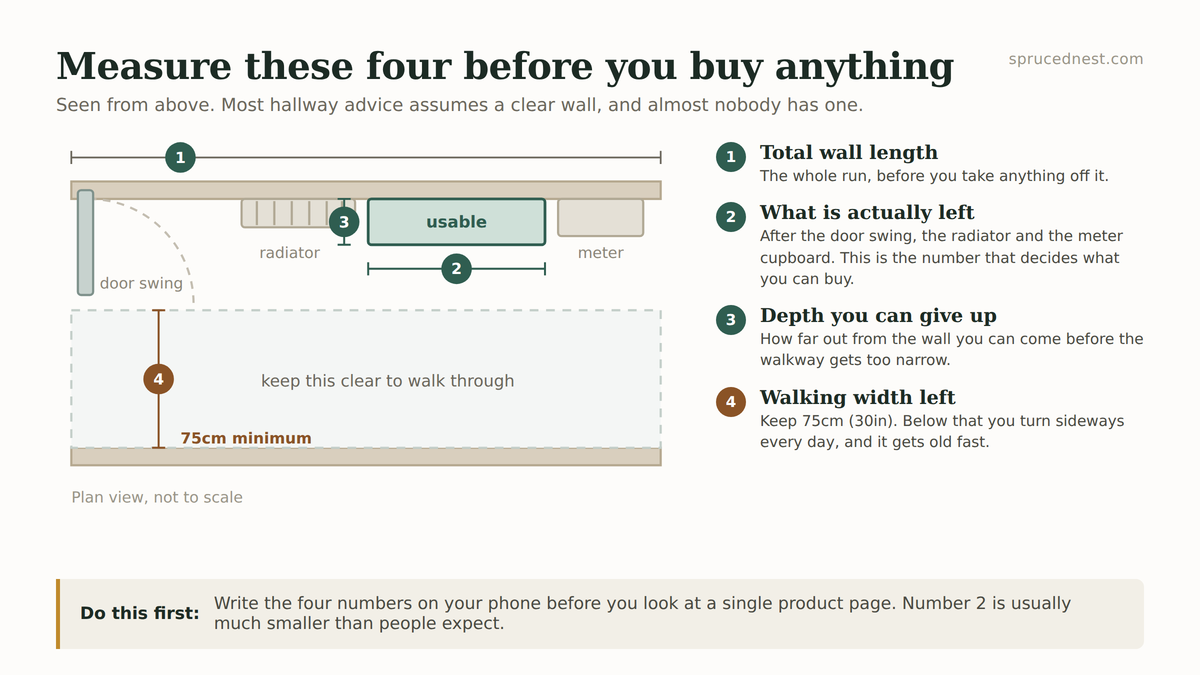
Take four numbers with a tape measure:
- Width at the narrowest point, usually by the door frame or a radiator.
- Door swing, meaning how far the front door opens into the hall.
- Wall height from the floor to the ceiling, or to the top of the door frame.
- Free wall length on each side, ignoring switches, outlets and the thermostat.
As a rough guide, try to keep a clear walkway of around 80 to 90cm (roughly 32 to 36 inches). Anything you add should come out of the remaining space, not the walkway.
Also check what’s fixed in place. A radiator, a meter cupboard or a light switch at the wrong height can rule out a whole wall. It’s much easier to find that out with a tape measure than after a delivery arrives.
Finally, think about traffic. Count how many people come through the door each day, and how many coats, bags and pairs of shoes they drop. Ultimately, that number tells you how much capacity you need far better than any product photo.
Small entryway storage for hallways under 90cm (3 feet)
This is the tightest group. As a result, small entryway storage has to live flat against the wall or above head height. In contrast, floor furniture deeper than about 20cm will cause problems.
1. Wall hooks, the slimmest small entryway storage
Hooks take almost no depth. Plus, and they’re faster to use than any cupboard. Choose solid hooks screwed into studs or proper wall anchors, because a loaded coat rail is heavier than it looks.
Best for: mainly coats, bags and dog leads you grab every day.
2. A slim wall-mounted shoe cabinet
Some tilt-out shoe cabinets, for example, measure just 17 to 24cm from front to back. That’s because shoes sit at an angle inside, so they take far less depth than a flat rack.
Best for: households with four to eight pairs in daily use.
3. A high shelf above the door
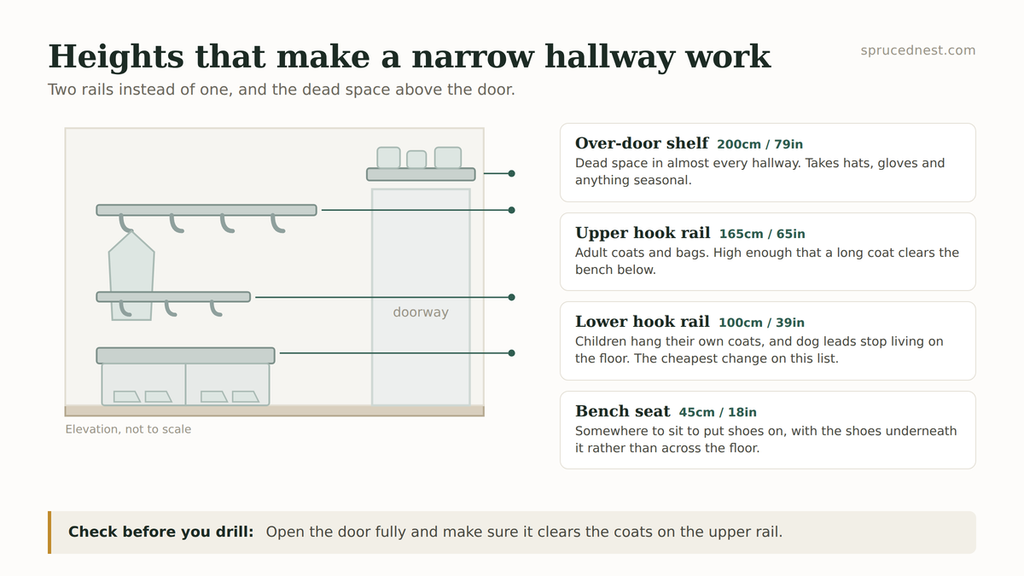
Meanwhile, the space above the front door is usually empty. A sturdy shelf there holds things you need seasonally, like hats, gloves and spare umbrellas, in baskets.
Best for: out-of-season items you reach for once a week or less.
4. Over-the-door organizers
If you have a coat closet or a door into another room, an over-the-door pocket organizer adds storage without using any floor or wall.
Best for: renters and anyone who can’t drill.
5. A narrow picture ledge for keys and mail
Similarly, a 10cm-deep ledge at waist height gives keys, sunglasses and letters a home. Even better, it’s shallow enough not to catch your hip.
Best for: the small items that usually end up on the floor or the stairs.
Small entryway storage for hallways 90cm to 110cm wide
With a little more room, you can add one piece of floor furniture. The trick is keeping it shallow and choosing one item, not three.
6. A shallow bench with storage inside
First, look for benches around 30 to 35cm deep. A lift-up seat hides shoes and bags, and you get somewhere to sit while you deal with laces. This is the single most useful piece of small entryway storage if you have the width.
Best for: families with kids, and anyone who struggles to balance while putting on shoes.
7. A double hook rail at two heights
Mount one rail at adult height and a second, lower rail around 90 to 100cm from the floor. As a result, kids can hang their own coats, which means fewer coats on the floor.
Best for: households where children don’t reach the top rail.
8. A tall, narrow cabinet in a corner
Basically, a tall unit uses height instead of depth. However, tall furniture can tip, especially with heavy doors open or kids climbing it. Always anchor it to the wall. The U.S. Consumer Product Safety Commission’s Anchor It campaign explains how tip-overs happen and how to secure furniture.
Best for: brooms, a vacuum, or bulk items you’d otherwise keep in the hall.
9. A wall-mounted mirror with a shelf
For example, a mirror makes a narrow hall feel wider, and a small shelf beneath it adds a drop zone. In other words, two jobs, one wall fixing.
Best for: halls that feel dark or closed in.
Small entryway storage for hallways wider than 110cm
At this width you can treat the entry like a proper storage zone. Even so, keep depth in check so the space still feels open.
10. Built-in floor-to-ceiling storage
For example, a shallow built-in run, around 30 to 40cm deep, can hold coats, shoes and cleaning gear behind closed doors. Of course, it costs more, but the result looks calm and uses every inch of height.
Best for: homeowners planning to stay put for a few years.
11. A bench plus open cube shelves
A bench with open cube shelves underneath and hooks above creates a mudroom feel without a mudroom. Then give each person one cube, and the clutter sorts itself.
Best for: busy households with pets and sports gear.
12. A boot tray and a washable mat
Similarly, a rubber boot tray catches wet and muddy shoes before they reach the floor. Pair it with a washable mat inside the door. For more on this, see our tips to stop muddy paw prints in the house.
Best for: rainy climates and homes with dogs.
Small entryway storage ideas for any width
13. Baskets with one simple rule
For instance, a basket per person for hats, gloves and scarves works well. The rule matters more than the basket: if it doesn’t fit in your basket, it goes back to your room.
Best for: stopping the slow creep of things left at the door.
14. A seasonal rotation system
Small entryway storage is never big enough for every coat and pair of shoes you own. So keep only current-season items by the door. Instead, move the rest to a closet or under the bed, and swap them when the weather changes. Our guide to organizing a small wardrobe has more space-saving ideas for the overflow.
Best for: anyone who has tried everything else and still runs out of room.
Making a narrow hallway feel wider
Still, storage is only half of it. A few visual tricks help a narrow hall feel less cramped:
- Keep the floor visible. After all, wall-mounted pieces show more floor, which reads as more space.
- Use lighter colors. Pale walls and a light runner also bounce light around.
- Choose closed storage for messy items. Otherwise, open shelves look busy fast. Doors hide the clutter.
- Add good lighting. Likewise, a bright ceiling light or a plug-in wall light makes the space feel larger.
Dust also builds up quickly by the door, where outdoor dirt arrives. These ideas to reduce dust at home start right at the entrance.
The verdict: which small entryway storage to buy first
If you’re only buying one thing, buy the item that matches your width:
| Hallway width | Start with | Then add |
|---|---|---|
| Under 90cm | Strong wall hooks | A slim tilt-out shoe cabinet |
| 90 to 110cm | A shallow lift-up bench | A second, lower hook rail |
| Over 110cm | A bench with cube shelves | A boot tray and baskets |
Whatever your width, mount things securely, keep the walkway clear, and resist filling every spare inch. A hallway with a little empty wall feels bigger and works better.
Begin with the piece that handles your biggest daily pile, whether that’s shoes, coats or bags. Next, live with it for a couple of weeks. Then decide what the space still needs, because the right small entryway storage is usually less than you’d expect.


One comment