How to Organize a Small Wardrobe So It Stays That Way
A weekend plan to organize a small wardrobe: sort and zone on Saturday, fold, fit and store on Sunday, then keep it tidy with a few easy habits.
A small wardrobe rarely stays tidy because of one big clear-out. It stays tidy because things are stored where your hands naturally reach, and because each item comes out without dragging three others with it.
The good news? You can set that up in a single weekend. Saturday is for sorting and zoning. Sunday is for folding, fitting, and storing what’s out of season. After that, a few small habits keep it working for months.
Before you start, grab some masking tape, a marker, a few lidded boxes, and a donation bag. Then clear the bed so you have somewhere to work.
The prep week: find out what you actually wear
This step is optional, but it makes Saturday far easier. A week or more before your weekend, turn every hanger in your small wardrobe backward, with the hook facing the wrong way. When you wear something and put it back, hang it the normal way round.
For folded things, stick a strip of masking tape across the shelf. Move each item to the left of the tape once you’ve worn it.
The longer you leave it, the clearer the picture. Ideally, run it for a full season. Anything still facing backward hasn’t been worn in that time. That isn’t an order to throw it out. It’s simply honest information, and it beats standing in front of the rail asking yourself if you like something.
Saturday morning: empty your small wardrobe and sort
1. Take everything out of the small wardrobe
Empty the whole wardrobe onto the bed. Yes, everything. You can’t plan a small wardrobe while half of it is still hidden at the back.
2. Sort into four piles
- Wear often: clothes you’ve reached for in the last few weeks.
- Wear sometimes: weekly items like gym clothes, bags, and smart shoes.
- Out of season or occasion wear: heavy coats in summer, swimwear in winter, formal outfits.
- Not sure: anything the hanger test caught, or anything you hesitate over.
3. Box the “not sure” pile
Don’t force decisions now. Instead, put the uncertain items in a box, write today’s date on it, and store it out of the way. If you haven’t opened it in six months, you have your answer, without a stressful afternoon of second-guessing.
Saturday afternoon: zone the small wardrobe
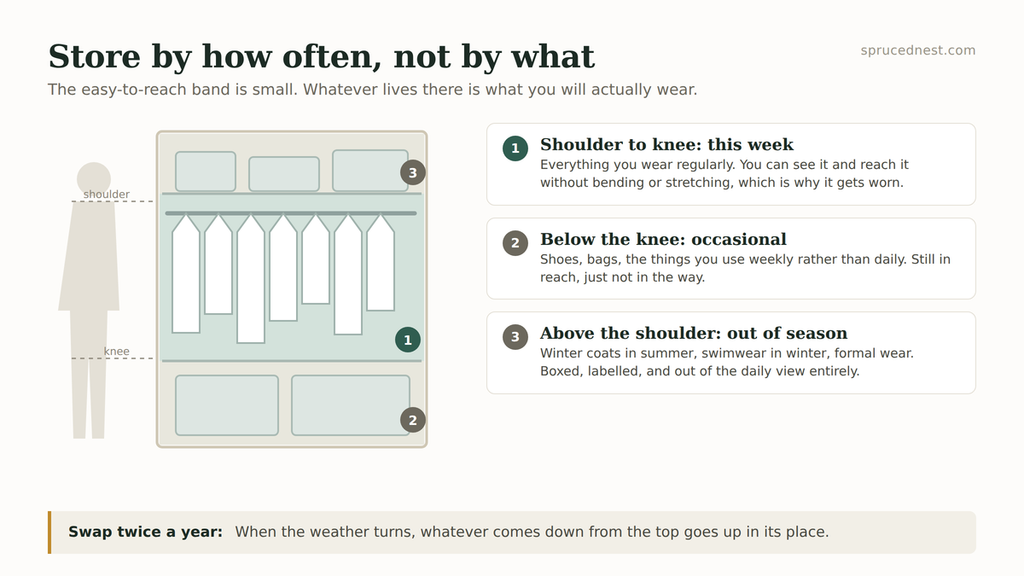
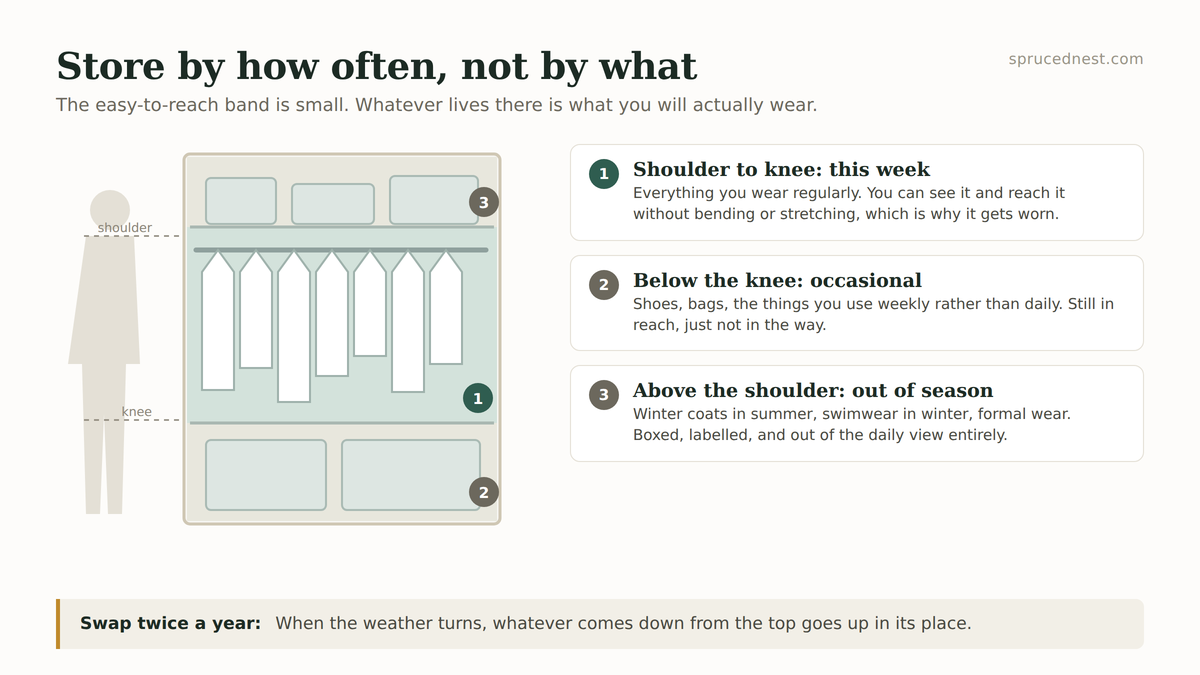
Every wardrobe has one band that’s genuinely easy to use, roughly from shoulder height down to the knee. Things in that band can be seen at a glance and taken out without bending or stretching. Things outside it get used less, simply because they take more effort.
In most closets, that prime band is full of clothes nobody wears. So flip it:
- Shoulder to knee: what you wear this week. That means the rod, the front of the top drawer, and the shelf at chest height.
- Below the knee: weekly things such as shoes, bags, and workout gear.
- Above the shoulder: out-of-season clothes and occasion wear, boxed and labeled so you never have to pull a box down to check what’s inside.
Now hang the “wear often” pile back first, in the prime band. Then fill the lower and upper zones around it.
Sunday morning: fold, file and fit more in
Stop stacking and start filing in a small wardrobe
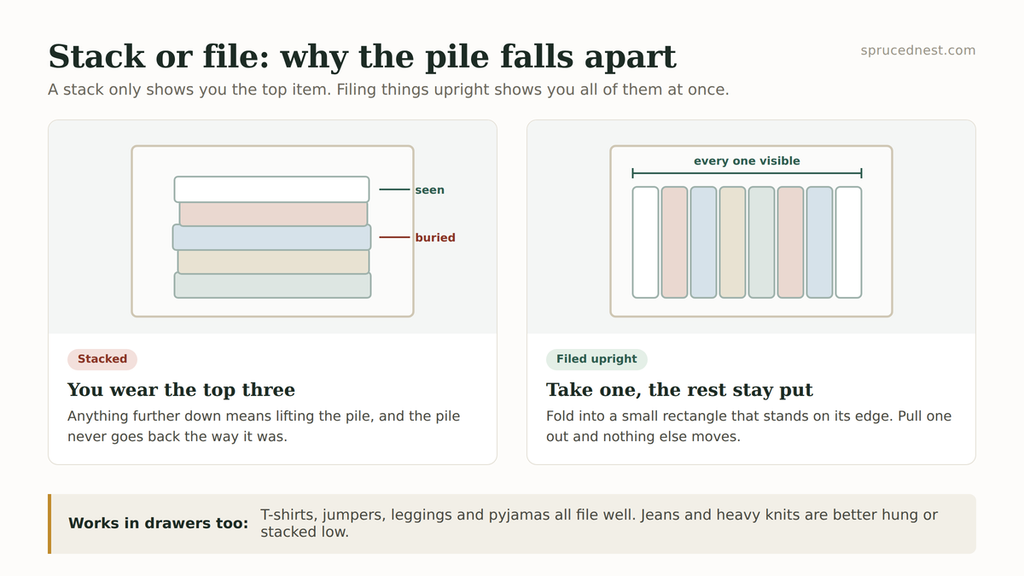
A stack of folded clothes only shows you the top item. You wear the top two or three and forget the rest exist. Also, pulling something from the middle wrecks the pile, which is how a neat shelf turns into a heap.
Filing fixes both problems. Here’s how to fold for it:
- Lay the item flat and fold the sides in to make a long rectangle.
- Fold it in half lengthwise, then in half or thirds again until it forms a small, firm block.
- Stand it on its folded edge. If it flops, fold it once more.
- Line the blocks up front to back in a drawer or shelf box, folded edge facing up.
Filing works best for T-shirts, light sweaters, leggings, pajamas, and underwear. Heavy knits and jeans are too bulky, so keep those in short stacks of three or four. On open shelves, shelf dividers or old shoe boxes hold filed rows upright.
Space boosters for a small wardrobe
- Matching slim hangers. Thin, non-slip hangers take up far less rod space than chunky wooden or mixed ones. Clothes stop sliding off, and the rod looks calmer too.
- A second rod under short items. If you mostly hang shirts and tops, there’s wasted space below them. A hanging rod extender hooks over the main rod and doubles capacity in that section.
- The inside of the door. Over-door hooks or a shallow organizer can hold belts, scarves, and bags. Check the door still closes before you commit.
- Coats elsewhere. Everyday outdoor coats eat a huge share of rod space. If you can, move them to hooks by the front door. Our guide to storage for a narrow entryway has ideas that work in tight halls.
Sunday afternoon: clear off-season clothes from a small wardrobe
Clothes stored for six months come back in the condition you packed them. So get these steps right:
- Wash everything first. The University of California’s pest notes on clothes moths say fabrics stained with food or sweat are more likely to be damaged. They also advise storing items only once they’re clean.
- Make sure it’s bone dry. Anything packed even slightly damp can come out musty or spotted with mold.
- Use lidded boxes or zip bags. They keep dust and insects out. For wool, a breathable cotton storage bag is a good option.
- Label the outside. “Winter sweaters and scarves” saves you opening four boxes in October.
- Avoid exterior walls if you can. Cold outside walls attract condensation, and the back of a wardrobe is a common spot for mold. These tips to stop condensation on windows also help with damp air in general.
- Keep vacuum bags for bedding. They’re great for bulky comforters. However, compressing wool or structured clothes for months can crush the fibers and leave permanent creases.
Finally, put the donation bag in your car. If it stays in the house, it tends to creep back into the closet.
Maintenance: keep your small wardrobe tidy
Most wardrobes don’t get messy on their own. The real culprit is usually the chair next to them, piled with clothes that aren’t dirty enough to wash or clean enough to put back. These habits stop that pile from forming:
- Give half-worn clothes a home. A single hook on the bedroom door or a small basket works well. It just shouldn’t be the wardrobe or the floor.
- Hang things up straight away. Draping them over the chair “for now” takes the same thirty seconds.
- One in, one out. When something new comes home, ask whether something else can leave.
- Swap seasons on fixed weekends. Twice a year, when the weather turns, swap the top boxes with the rod. Pick the same weekends every year so it becomes routine.
- Sort first, buy storage second. Boxes bought in advance are almost always the wrong size. Measure what’s left after sorting, then shop.
Small wardrobe systems that tend to fail
Organizing purely by color looks lovely in photos. In practice, most people dress by type, so they end up scanning the whole rod every morning. Color works well within a category, though. Similarly, fabric hanging shelves often sag, and their lower pockets are awkward to reach in a small wardrobe.
Frequently asked questions
Should sweaters be hung or folded?
Folded, in almost every case. Knitwear stretches on a hanger and develops shoulder bumps. File lighter sweaters in a drawer and keep heavy ones in short stacks.
How do I stop clothes from slipping off hangers?
Use non-slip velvet or rubber-coated hangers. As a bonus, they’re usually slimmer than other types, so you gain rod space too.
Why does my wardrobe smell musty?
Usually damp is to blame, either from clothes put away not quite dry or from condensation behind a wardrobe on an outside wall. Empty it, leave the doors open for a day, and pull it an inch or two away from the wall. Then check the back panel for mold before you refill it.
How often should I reorganize a small wardrobe?
With zones in place, a full reorganization is rarely needed. A quick tidy each week and the two seasonal swaps are usually enough.
Your small wardrobe weekend checklist
| When | Task | Done when |
|---|---|---|
| Prep week | Turn hangers backward | You know what you really wear |
| Saturday morning | Empty, sort into four piles, box the “not sure” items | The bed is clear and the box is dated |
| Saturday afternoon | Zone shoulder to knee for everyday clothes | Daily outfits are in easy reach |
| Sunday morning | File folded clothes, add slim hangers and a second rod | Every folded item is visible |
| Sunday afternoon | Wash, dry, box and label off-season clothes | Boxes are up high and labeled |
| Every week | Clear the half-worn hook and hang things straight away | The chair stays empty |