How to Stop Your Cat Scratching the Sofa (Without Punishing Them)
Cat scratching on the sofa is fixable without punishment. Answers to the most common questions on posts, placement, deterrents and rewards.

Is cat scratching slowly turning one corner of your sofa into loose threads? You’re not alone, and the fix is rarely about stopping the habit. It’s about moving it somewhere you don’t mind.
Cats need to scratch. So the goal with cat scratching here isn’t a cat that never scratches. It’s a cat that walks past the sofa and heads for a post you chose. Below are the questions owners ask most often, answered in the order you’ll need them.
Quick answer: Put a tall, sturdy sisal post right next to the damaged spot, make the sofa unpleasant to scratch for a few weeks, and reward your cat every time they use the post. Never punish them.
Why does my cat scratch the sofa when they have a post?
Usually it’s because the sofa does the job better. A good scratch needs a surface that grips the claws, holds firm, and lets your cat stretch out fully. A plush arm that’s tall, heavy and textured ticks every box.
Cats scratch for a few reasons at once:
- Claw care. Scratching pulls away the worn outer layer of each claw.
- Stretching. A long pull works the back, shoulders and front legs, which is why it often happens right after a nap.
- Marking. Paw pads carry scent glands, so a scratch leaves a smell as well as a visible mark.
- Feelings. Excitement, frustration or a new arrival in the house can all trigger a burst of scratching.
That marking point matters, because once a spot smells like “theirs”, your cat keeps going back to it. Cats Protection explains this in more detail in its guide to why cats scratch.
In other words, cat scratching follows the best surface on offer. So if your current post is short, wobbly, or tucked away in a spare room, it simply loses the contest.
What kind of scratching post will my cat actually use?
Think tall, heavy and rough. After all, most cats ignore posts that tip over or are too short to stretch against.
Look for these features:
- Height. Your cat should be able to stretch fully upright with front paws on the post. For most adult cats that means at least 80cm (about 32 inches).
- Stability. A wide, weighted base. If it rocks when you push it, your cat will give up on it.
- Texture. Sisal rope or sisal fabric suits most cats. Carpet-covered posts can confuse things because they feel a lot like rugs.
- Direction. Some cats prefer to scratch flat on the floor. If yours attacks the rug or the stair runner, add a flat cardboard scratch pad too.
Before you buy, watch the cat scratching style you’re dealing with. Are they standing tall against the arm, or pulling at the base? Copy that angle with the post you buy.
Where should I put the post to stop cat scratching on furniture?
Right in front of the damage. In other words, not across the room, and not in a quiet corner.
This is the step most people skip, and it’s the one that ends most cat scratching problems. Because scratching is partly about marking a visible, busy area, a post hidden in a back bedroom won’t compete with the living room sofa.
Place the new post directly against the spot your cat targets. If they go for both arms, use two posts. Once your cat has used it reliably for a few weeks, you can move it a little at a time, say 30cm every few days, to a spot you prefer.
Good places to add more posts:
- Beside the sofa or chair they already scratch.
- Near where they sleep, since many cats scratch on waking.
- By the main door or hallway, where marking matters most.
How do I make the sofa less tempting for a while?
Make it boring or unpleasant to scratch. However, do this only while the new habit forms. You want the post to feel like the obvious choice.
Options that work for many cats:
- Cover the target area with a throw, a fitted cover or a sheet tucked in tight. Loose fabric is less satisfying to pull.
- Use double-sided tape made for furniture. Most cats dislike the sticky feel on their paws.
- Try plastic corner guards that screw or pin onto the arm. They’re cheap and fairly discreet.
- Clean the spot with an enzyme cleaner to reduce the scent mark. Our guide to getting pet urine smell out of carpet explains how these cleaners break down odors.
Also, avoid strong citrus or essential-oil sprays. Some essential oils can be harmful to cats, and a scent that’s strong to you is far stronger to them.
Is it OK to spray or shout at my cat for scratching?
No. A telling-off won’t show your cat where scratching is allowed. It mostly shows them that you’re unpredictable.
For example, shouting, spraying water or clapping can make a cat anxious. And anxious cats often scratch more, not less. Some will simply wait until you leave the room.
Instead, calmly interrupt and redirect:
- Make a neutral sound or wave a wand toy to break their focus.
- Lift them gently, or lure them, to the post right beside the sofa.
- Run your fingers down the post to show them the texture.
- Praise or treat the moment their claws hit the post.
How do I make the cat scratching post more appealing?
Make good things happen there, since cats repeat whatever pays off.
- Rub a little catnip or silver vine on the post. Not every cat reacts, but many do.
- Play with a wand toy around and up the post so their claws catch it naturally.
- Give a small treat or a short fuss right after they scratch it.
- Feed a meal or offer a favorite treat near the post.
Above all, keep sessions short and positive. Two or three minutes of play by the post each evening is plenty.
Does trimming claws help with cat scratching damage?
It helps reduce damage, though it won’t stop the urge. Shorter, blunter claws snag less fabric when your cat does slip back to the sofa.
Trim only the clear tip and avoid the pink quick, which contains blood vessels and nerves. If you’re unsure how, ask your vet or a vet nurse to show you once. Many cats tolerate one or two claws at a time with a treat in between.
In particular, older indoor cats may need regular trims, since they scratch and wear their claws down less.
Soft claw caps are another option some owners use. If you try them, follow your vet’s advice on sizing and fitting.
Could boredom or stress be behind it?
Yes. Sudden or frantic cat scratching is often a sign that something in the home has shifted. Cats often scratch more when something has changed.
For instance, common triggers include a new pet, a house move, visitors, building work, or a cat outside the window. Indoor cats with little to do may scratch simply out of pent-up energy.
Some changes that help:
- Two short play sessions a day with a wand toy.
- Window perches and shelves so your cat can climb and watch.
- Puzzle feeders to make mealtimes more of a hunt.
- A quiet, high resting spot they can retreat to.
If the scratching comes with other changes, like hiding, licking their fur bare or toileting outside the tray, speak to your vet. These can point to stress or a health problem that needs attention.
Is declawing a fix for cat scratching?
No. Declawing is surgery that removes part of each toe, not just the claw. It’s illegal in the UK and restricted in several US states, and animal welfare charities oppose it.
Instead, every approach in this guide works without surgery. It just takes a few weeks of patience.
Which sofas hold up best against claws?
If you’re replacing furniture anyway, fabric choice makes a real difference.
| Fabric type | How it handles claws |
|---|---|
| Tight-weave microfiber | Hard for claws to hook into, and easy to brush clean |
| Leather or faux leather | Not loop-based, but scratches and punctures show |
| Velvet with a short pile | Often less tempting than loose weaves |
| Loose weaves and loop textures | Very tempting, and pulls easily |
As a bonus, tight, smooth fabrics also hold less fur. For day-to-day upkeep, see our tips on removing pet hair from carpets, sofas and clothes.
What should I do first, starting today?
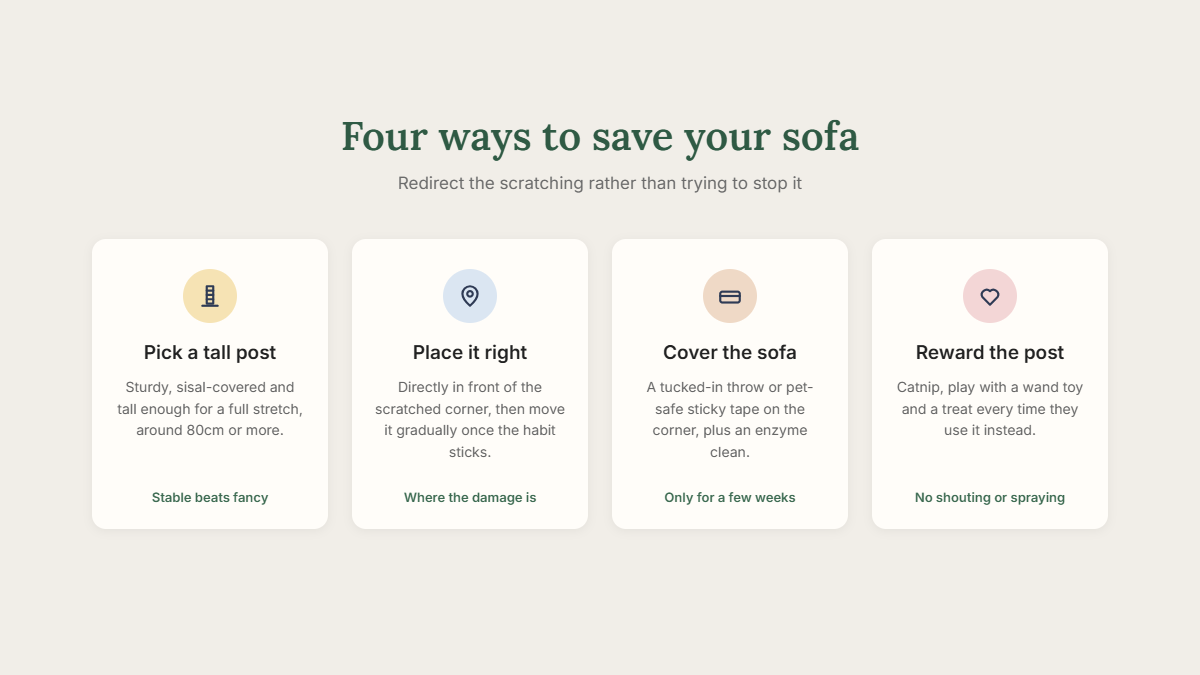
Keep it simple. Here’s a four-step plan to stop cat scratching on the sofa this week:
- Today: Buy or move a tall, heavy sisal post and stand it right against the damaged spot.
- Today: Cover that part of the sofa with a tight throw or furniture tape.
- Every day: Play by the post and reward every scratch on it.
- After three to four weeks: Uncover the sofa, keep the post in place, and only then start moving it gradually if you want to.
In the end, most cats switch once the post is the better option. Make it the better option, and the sofa gets left alone.