How to Clean an Oven Without Scrubbing
Four ways to clean an oven without scrubbing, compared side by side: baking soda paste, steam, the self-clean cycle and commercial cleaner, plus which one to choose.
Scrubbing is the least effective way to clean an oven. That sounds backward, but the brown layer coating most oven walls isn’t loose dirt. It’s grease that has been heated so many times it has turned hard and glossy, much like varnish. Elbow grease alone barely touches it.
So if you want to clean an oven without scrubbing, the real question is which softening method to use. There are four main options: a baking soda paste, steam, the self-clean cycle, and commercial oven cleaner. Each one suits a different oven, a different level of grime, and a different amount of patience.
Below, you’ll find how each method works, a side-by-side comparison, and a clear verdict on which to choose.
Before you clean an oven without scrubbing, check the lining
Before you pick any method, look at the inside surfaces. This one check decides whether you clean the oven or damage it.
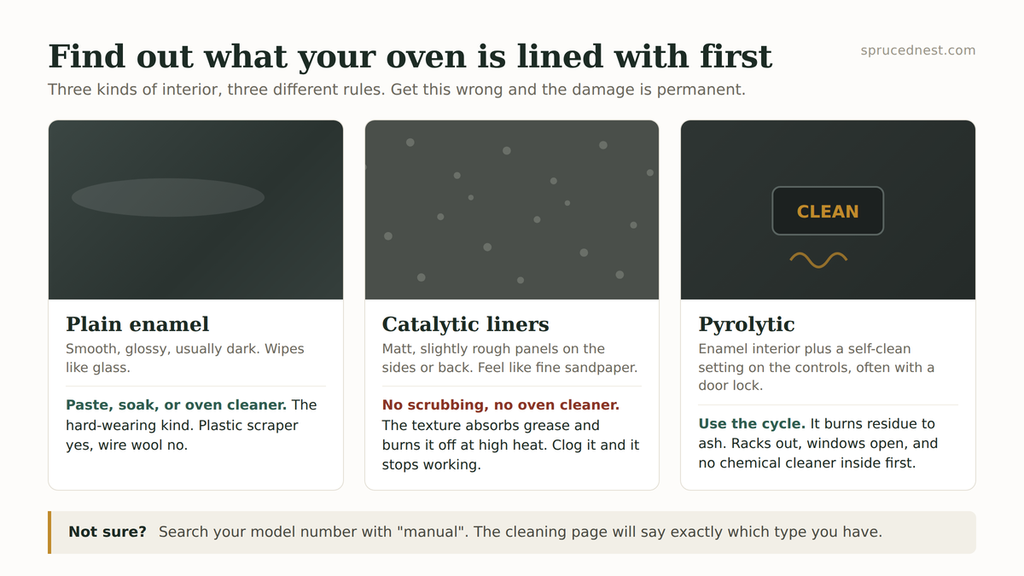
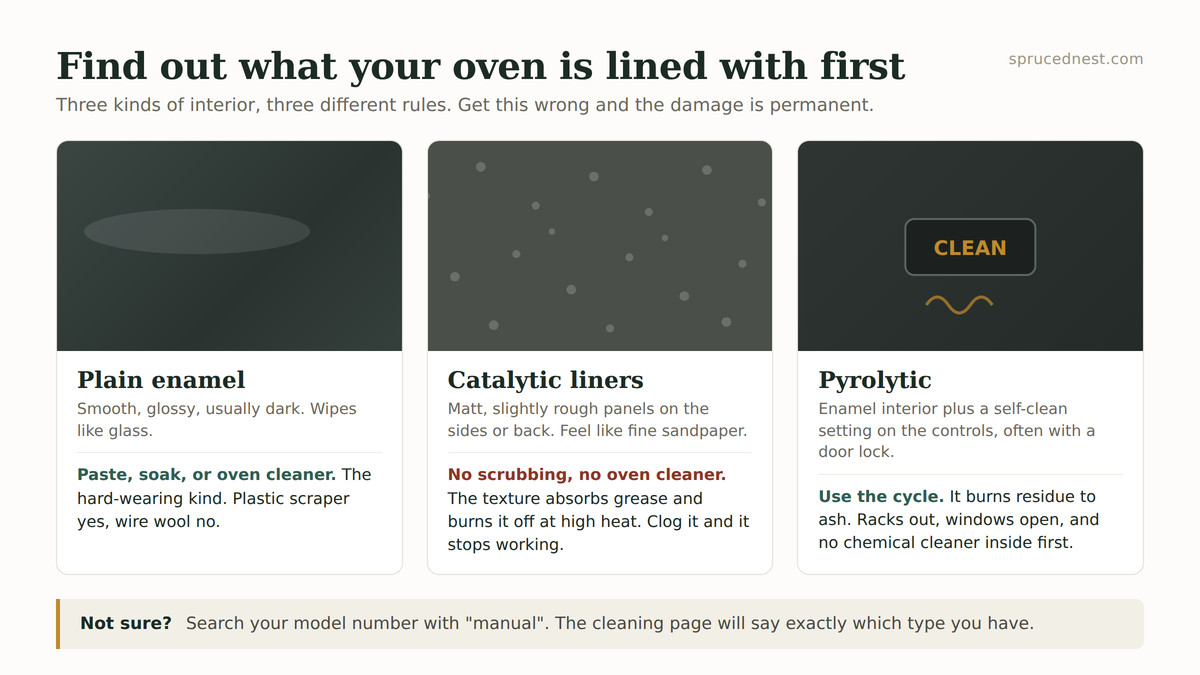
- Plain enamel is smooth and glossy. It’s the most forgiving finish, and every method below can work on it.
- Catalytic liners are matte panels with a slightly rough texture, usually on the sides, back or roof. That texture absorbs grease and breaks it down when the oven runs hot. Scrubbing them or spraying them with cleaner ruins the surface, so leave them alone. Running the oven empty at a high temperature for an hour now and then helps them along.
- Self-cleaning ovens have a special setting that heats the cavity far beyond cooking temperature and turns residue to ash.
Not sure which you have? Search your model number plus the word “manual.” The cleaning section usually says so in its first paragraph.
Why you can clean an oven without scrubbing
Baked-on fat breaks down with two things: an alkali and time. Commercial cleaners use a strong alkali to work fast. Baking soda is a much milder alkali that does the same job slowly. Either way, the cleaner has to stay damp and in contact with the grease while it works.
Scrubbing without that softening stage is like sanding varnish by hand. It’s possible, but it’s exhausting, and it scratches the enamel underneath. That’s why every method here aims to clean the oven without scrubbing at all.
Method 1: Clean an oven without scrubbing using baking soda paste
This is the cheapest way to clean an oven without scrubbing, and the gentlest on enamel. It takes about fifteen minutes of actual work, spread over two days.
- Make sure the oven is completely cold and switched off.
- Remove the racks, plus any shelf runners that lift out.
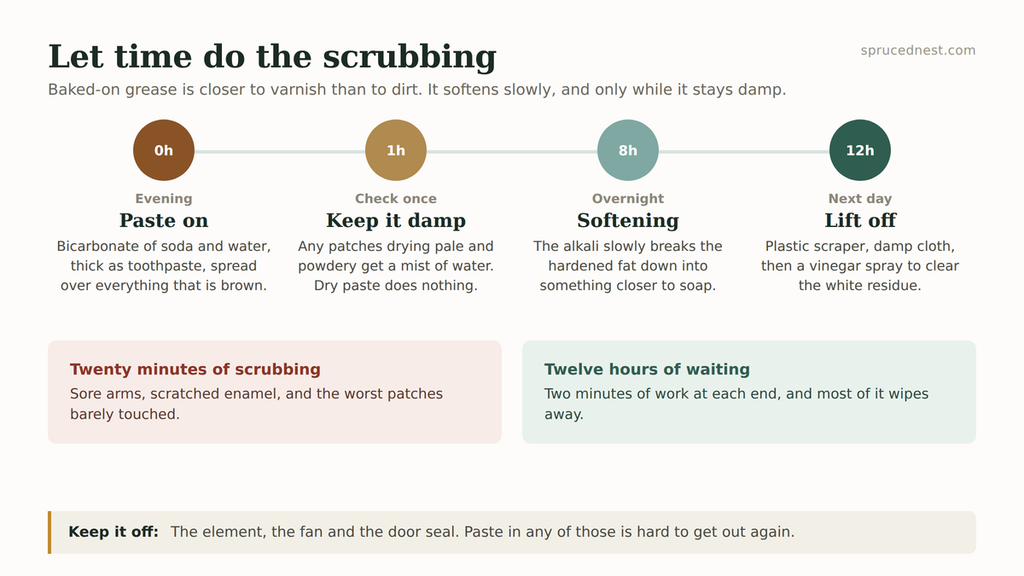
- Mix about half a cup of baking soda with a few tablespoons of water. Aim for a paste roughly as thick as toothpaste, and make more for a very greasy oven.
- Wearing gloves, spread it over every brown surface. Go thicker on the worst patches. It will turn brown as it meets the grease, which is normal.
- Keep paste off the heating elements, fan, door seal, gas inlet and any catalytic panels.
- Close the door and leave it for at least eight hours, ideally twelve. Check after an hour, and mist any pale, powdery patches with water. Dry paste does nothing.
- Next day, lift it off with a plastic scraper or an old gift card, then wipe with a damp cloth.
- Spray the white residue with diluted white vinegar and wipe again. It fizzes slightly, and the cloudy film clears.
Stubborn spots? Repeat the paste on just those areas. A second night is still faster than scrubbing them. Cornell Cooperative Extension describes a similar paste method as the safest option, though slower.
The door glass
The glass cleans up like the rest of the oven without scrubbing. Lay the door open flat, spread paste over the inner glass, and cover it with plastic wrap so it stays damp. Streaks between the panes are a separate problem. On many ovens the inner pane slides out after you remove a few screws or clips, so check your manual. If the door doesn’t come apart, leave it, since prying at the glass is an easy way to crack it.
Method 2: Steam cleaning with a bowl of water
Place an ovenproof dish of water, often with lemon slices, in the oven at around 400°F for 20 to 30 minutes. Let it cool slightly, then wipe the walls while they’re still warm and damp.
Steam is the quickest way to freshen an oven without scrubbing, and it softens light, recent splashes well. However, it does very little against years of baked-on buildup. It also makes the kitchen humid. Think of it as a quick freshen-up between deep cleans, not a deep clean itself.
Method 3: The self-clean cycle
If your oven has a self-clean setting, it’s the easiest way to clean an oven without scrubbing. The cycle reaches very high temperatures, so follow these rules from most manuals:
- Remove racks and runners unless the manual says they can stay in.
- Wipe out loose food and big spills first. Thick, burnt fat creates a lot of smoke.
- Don’t use any chemical cleaner inside beforehand, because the residue can damage the enamel at those temperatures.
- Open a window and run the range hood. The first cycle on a dirty oven will smell.
- Stay home while it runs, and keep people and pets out of the kitchen.
- Keep pet birds in another room with the door closed. Fumes from self-clean cycles can be harmful to birds, whose lungs are far more sensitive than ours.
- Once the oven has cooled and the door releases, wipe out the fine ash with a damp cloth.
Method 4: Commercial oven cleaner
It’s the fastest way to strip a filthy oven without scrubbing, and it’s worth it for a very neglected oven, a move-out clean, or a patch that survived two rounds of paste. Even so, most oven cleaners are genuinely caustic, so treat them with respect.
- Wear gloves and eye protection. These products can burn skin, and a splash in the eye needs urgent medical help.
- Ventilate well, with a window open and the kitchen door shut behind you.
- Never use it on catalytic liners, self-cleaning interiors, aluminum, or the outside of the oven. Check the can for the full list.
- Keep it off the elements, fan, and seals.
- Rinse thoroughly, then run the oven empty for about twenty minutes before cooking, with the window still open.
- Never mix it with other products, and rinse everything away before using a different cleaner.
Four ways to clean an oven without scrubbing, compared
| Method | Hands-on effort | Total time | Best for | Avoid on |
|---|---|---|---|---|
| Baking soda paste | Low | 12 to 24 hours | Enamel ovens with moderate to heavy grease | Catalytic liners, elements, seals |
| Steam | Very low | About 1 hour | Light, recent splashes | Heavy, old buildup |
| Self-clean cycle | Very low | 2 to 4 hours plus cooling | Self-cleaning ovens with any level of grime | Homes with pet birds nearby, ovens without the setting |
| Oven cleaner | Medium | 1 to 3 hours | Very neglected ovens, tight deadlines | Catalytic, self-cleaning, aluminum surfaces |
Finish the oven without scrubbing: soak the racks
Racks are awkward because grease hides in every joint. A soak beats any brush:
- Lay an old towel in the bottom of the bathtub so the racks don’t scratch it.
- Add the racks and cover them with hot water.
- Dissolve a few dishwasher tablets or a generous scoop of washing soda in the water.
- Leave overnight, then give the joints a quick brush and rinse.
- Clean the tub right away, because greasy water leaves a stubborn ring.
Running racks through the dishwasher is tempting, but it can dull chrome plating. Plus, all that loosened grease ends up in the filter, which is often why a dishwasher stops cleaning properly.
Keep your oven from getting that bad again
Grease wipes away easily when it’s fresh, and becomes rock hard after a dozen bakes. These habits make it easy to keep a clean oven without scrubbing:
- Wipe spills while the oven is warm, not hot, with a damp cloth.
- Put a baking sheet under anything that bubbles over, like pies and lasagna.
- Cover roasting pans for part of the cooking time where the recipe allows.
- Skip foil on the oven floor. Many manufacturers advise against it because it can affect cooking and fuse to the enamel.
- Repeat the paste method twice a year. A light coat on a lightly soiled oven takes ten minutes at each end.
The same soak-and-wait idea also works on a sticky microwave without scrubbing.
The verdict: which way to clean an oven without scrubbing?
For most enamel ovens, choose the baking soda paste. It’s cheap, gentle, and it shifts heavy grease with almost no effort, as long as you give it a full night.
If your oven has a self-clean setting, use it, after a quick wipe-out and with birds and pets well away.
Save commercial cleaner for emergencies, such as a badly neglected oven or a looming move-out date.
Use steam only for light touch-ups. It’s handy between deep cleans but won’t fix years of buildup.
Pick the method that matches your oven, set it up tonight, and let time do the hard work.



One comment