Dishwasher Not Cleaning Properly? A Symptom-by-Symptom Fix List
A symptom-by-symptom checklist for a dishwasher not cleaning properly, covering filters, spray arms, detergent, water temperature and loading.
Is your dishwasher not cleaning the way it used to? Maybe glasses come out cloudy, or there’s grit on the top rack, or a film on everything. Before you call a repair technician, know this: most cleaning problems come down to a handful of simple, fixable causes.
This guide works like a checklist. Find the symptom that matches yours, run the check, then apply the fix.
Why a dishwasher not cleaning usually has a simple cause
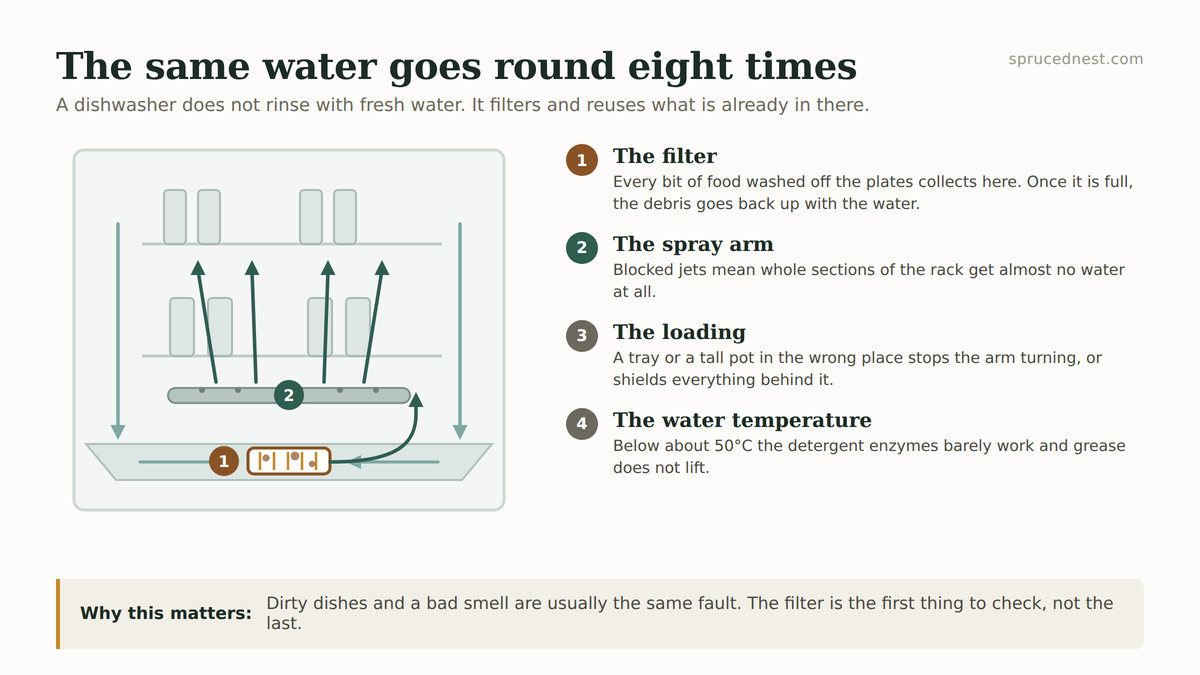
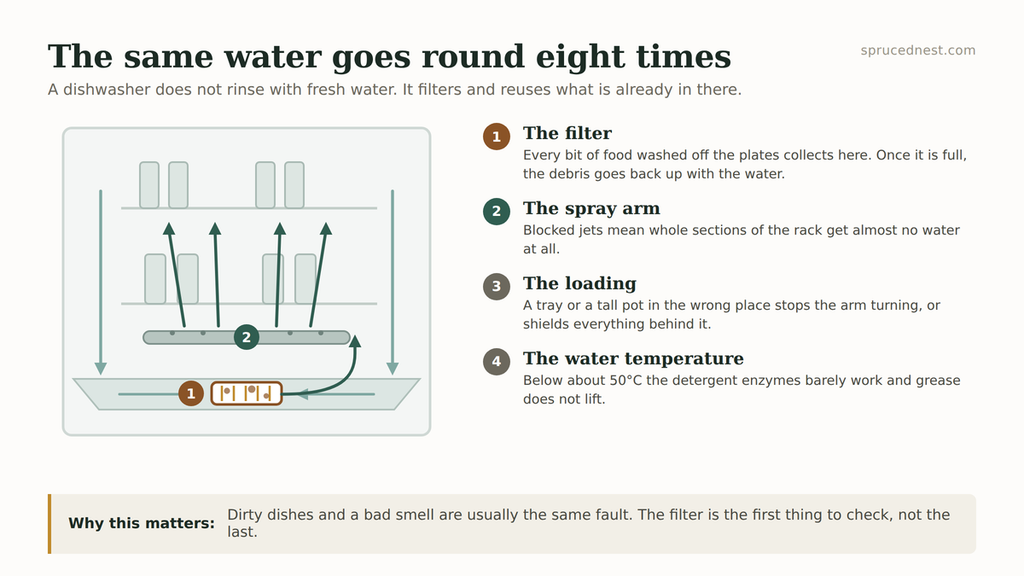
A dishwasher doesn’t use much water. Instead, it pumps the same small amount through the spray arms again and again, through a filter, and back out. Detergent, heat and water pressure do the cleaning. The heater warms the water, the pump pushes it through the arms, and the detergent breaks down food and grease.
So if any one of those breaks down, results drop fast. In most cases, a dishwasher not cleaning well is a maintenance issue, not a broken machine. A blocked filter means dirty water gets sprayed back on your dishes. A clogged spray arm means some areas barely get wet.
The quick checklist for a dishwasher not cleaning
Start here. These checks cover the majority of problems, and they’re listed in the order worth trying.
| Symptom | Check | Fix |
|---|---|---|
| Grit or food bits on dishes | Filter | Remove and rinse the filter |
| Top rack dirty, bottom fine | Upper spray arm | Clear the holes, check it spins |
| Dishes dirty in one area | Loading | Stop blocking spray arms |
| White film or cloudy glasses | Hard water | Use rinse aid, check salt or detergent |
| Greasy film | Water temperature | Run the kitchen tap hot first |
| Detergent left in the dispenser | Dispenser door | Load so nothing blocks it |
| Bad smell and poor results | Filter and drain | Deep clean the filter and sump |
Symptom 1: Grit, food bits or sand on clean dishes
Check: the filter at the bottom of the tub. Most modern machines have a manual filter you remove by twisting.
Fix: Lift it out, then rinse it under warm running water. Use a soft brush and a drop of dish soap on the mesh. Refit it firmly so it locks in place.
A dirty filter is the single most common reason for a dishwasher not cleaning properly, and it’s the easiest to fix.
How often? For most households, once a month is a good starting point. If you rarely scrape plates, it may need cleaning every week or two.
Symptom 2: Dishwasher not cleaning the top rack
Check: the upper spray arm, which sits under the top rack. Spin it by hand. It should turn freely.
Fix: Remove the arm, following your manual. Then poke out any trapped food or mineral buildup from each hole with a toothpick. Rinse it through and refit it.
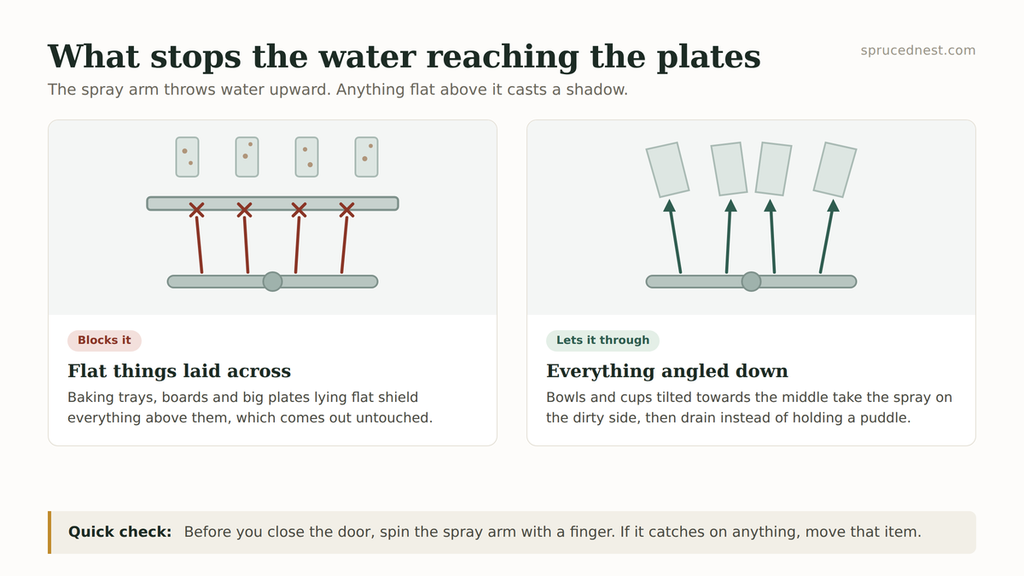
Also make sure a tall pan or tray on the bottom rack isn’t stopping the arm from spinning. That’s one of the most common reasons for a dishwasher not cleaning the top rack.
Symptom 3: Dishwasher not cleaning evenly
Check: how the machine is loaded.
Fix: Water needs a clear path to every surface. So face dirty sides toward the center and the spray arms. Don’t nest bowls, and keep large items to the sides and back. Leave space between plates, too.
Overloading is a frequent cause of patchy results. In fact, a dishwasher not cleaning bowls on one side is often just loaded too tightly. If you’re cramming everything in, you’ll often get a better clean from two lighter loads.
Symptom 4: White film or cloudy glasses
Check: whether it wipes off. Then try the vinegar test: soak a cloudy glass in white vinegar for a few minutes.
Fix: If the film dissolves, it’s mineral deposits from hard water, a classic cause of a dishwasher not cleaning glasses well. Keep the rinse aid topped up, and if your machine has a salt reservoir, keep it filled. Using the right amount of detergent for your water hardness helps too.
If the cloudiness doesn’t come off, the glass may be etched. That’s permanent damage, often from too much detergent in soft water, or very hot cycles. Use less detergent and a gentler cycle for glassware.
Hard water affects more than your dishwasher. Our guide on how to descale a kettle covers the same mineral buildup in another common appliance.
Symptom 5: A greasy film on dishes
Check: the water temperature. Dishwashers rely on hot water to dissolve grease, so a dishwasher not cleaning greasy pans is often running too cool.
Fix: Before starting a cycle, open the hot tap at the sink and let it run until the water feels hot. This way the machine fills with hot water from the first minute. Choose a normal or heavy cycle for greasy loads, rather than an energy-saving or quick setting.
Also check the detergent. Old powder that has clumped in a damp cupboard doesn’t dissolve well.
Symptom 6: Detergent is still in the dispenser
Check: whether something blocks the dispenser door from opening. A tall plate, cutting board or baking sheet is the usual culprit. Without detergent, any dishwasher not cleaning well will only get worse.
Fix: Load tall items away from the dispenser. And if you use pods, put them in the dispenser rather than the bottom of the tub, unless your manual says otherwise.
Symptom 7: Smell plus poor cleaning
Check: the filter, the sump beneath it, and the drain area. Trapped food breaks down and smells, which is why a dishwasher not cleaning often smells as well, and it also stops the water draining properly.
Fix: Clean the filter, then wipe out the sump with a cloth. Check the drain hose isn’t kinked behind the machine. If your kitchen sink drains slowly too, the shared drain may be the issue. Our guide to unblocking a kitchen sink can help.
Once it’s clean, run an empty hot cycle with a dishwasher cleaner or a cup of white vinegar on the top rack. Never combine vinegar with bleach-based cleaners. The fumes are hazardous.
Habits that keep the problem from coming back
Once your dishes are coming out clean again, a few small habits keep them that way. None of them take more than a minute, and together they stop a dishwasher not cleaning from becoming a repeat problem.
- Scrape, don’t rinse first. Detergents are designed to work on some food soil. Scraping off big pieces is enough.
- Clean the filter monthly. Put a reminder on your calendar.
- Use the right cycle. Quick cycles are handy but less thorough on dried-on food.
- Run it full, not crammed. A full but well-spaced load cleans best.
The U.S. Department of Energy’s Energy Saver guide to kitchen appliances also has tips on running a dishwasher efficiently.
When a dishwasher not cleaning needs a technician
Some problems aren’t fixable at home. For example, a dishwasher not cleaning because it barely fills with water may have a faulty inlet valve, which is a job for a professional. Call a qualified technician if:
- The machine doesn’t fill with water, or doesn’t drain at all.
- You hear grinding or loud humming from the pump.
- Water isn’t getting hot, even after running the tap first.
- There’s a leak from under the machine.
Frequently asked questions
Why is my dishwasher not cleaning the top rack?
Usually the upper spray arm is clogged or blocked by a tall item on the bottom rack. Clean the holes and make sure it spins freely.
How often should I clean the dishwasher filter?
About once a month for most homes. Clean it more often if you don’t scrape plates or if you notice grit on dishes.
Do I need rinse aid?
It’s very helpful, especially with hard water. Rinse aid helps water sheet off dishes, which reduces spots and film and helps drying.
Can a dishwasher not cleaning be caused by cheap detergent?
Sometimes. Detergent quality and the right dose for your water hardness both matter. If a better detergent doesn’t help, go back to the checklist above.
Next step
If your dishwasher not cleaning properly has been driving you up the wall, start with the filter. It takes five minutes, needs no tools, and fixes more dirty-dish complaints than anything else. If that doesn’t do it, work down the checklist one symptom at a time.