How to Descale a Kettle (and Stop Limescale Coming Back)
How to descale a kettle with vinegar, citric acid, lemon or a commercial descaler, with a side-by-side comparison and the best choice for each situation.
Quick answer: To descale a kettle, half-fill it with a mild acid solution (white vinegar and water, citric acid, or lemon juice), boil it, leave it to soak, then empty it and boil fresh water once or twice to rinse. Citric acid is the best all-rounder.
That’s the short version. Which method suits you depends on how bad the scale is, how much you mind a vinegar smell, and what your kettle is made of. Below, you’ll find all four common methods side by side, then a verdict for each situation.
Why kettles scale up
Limescale is the chalky white or brown crust that builds up on the element and walls. It comes from minerals dissolved in tap water, mainly calcium and magnesium. The more of these your water carries, the “harder” it is, as the US Geological Survey explains in its overview of water hardness.
When water is heated, some of those minerals come out of solution and stick to hot surfaces. So, the harder your water and the more often you boil, the faster scale appears.
Scale is mostly a nuisance. It leaves flakes in your tea, makes the kettle look grubby, and can coat the heating element, which may make the kettle slower to boil.
Signs it’s time to descale
You don’t need to wait for a thick crust. Look out for:
- White or tan flakes floating in boiled water or in your mug
- A rough, chalky coating on the element plate or the inside walls
- A cloudy film on a glass kettle
- Louder rumbling while it heats
- A kettle that seems to take longer to boil than it used to
Any one of these means it’s a good time to descale a kettle, before the layer gets harder to shift.
Four ways to descale a kettle, compared
All four methods work the same way. A mild acid dissolves the mineral crust so it rinses away. They differ in strength, smell, cost and how long they take.
| Method | Strength | Smell | Typical soak | Best for |
|---|---|---|---|---|
| White vinegar | Good | Strong, needs extra rinsing | 30 to 60 minutes | Moderate scale when you already have vinegar |
| Citric acid | Very good | Almost none | 15 to 30 minutes | Regular descaling, most kettles |
| Lemon juice | Mild | Pleasant | About 1 hour | Light scale, frequent upkeep |
| Commercial descaler | Strong | Low | As per label | Heavy, stubborn scale |
How to descale a kettle with vinegar
Vinegar is cheap, and most kitchens already have it. However, the smell lingers if you don’t rinse well.
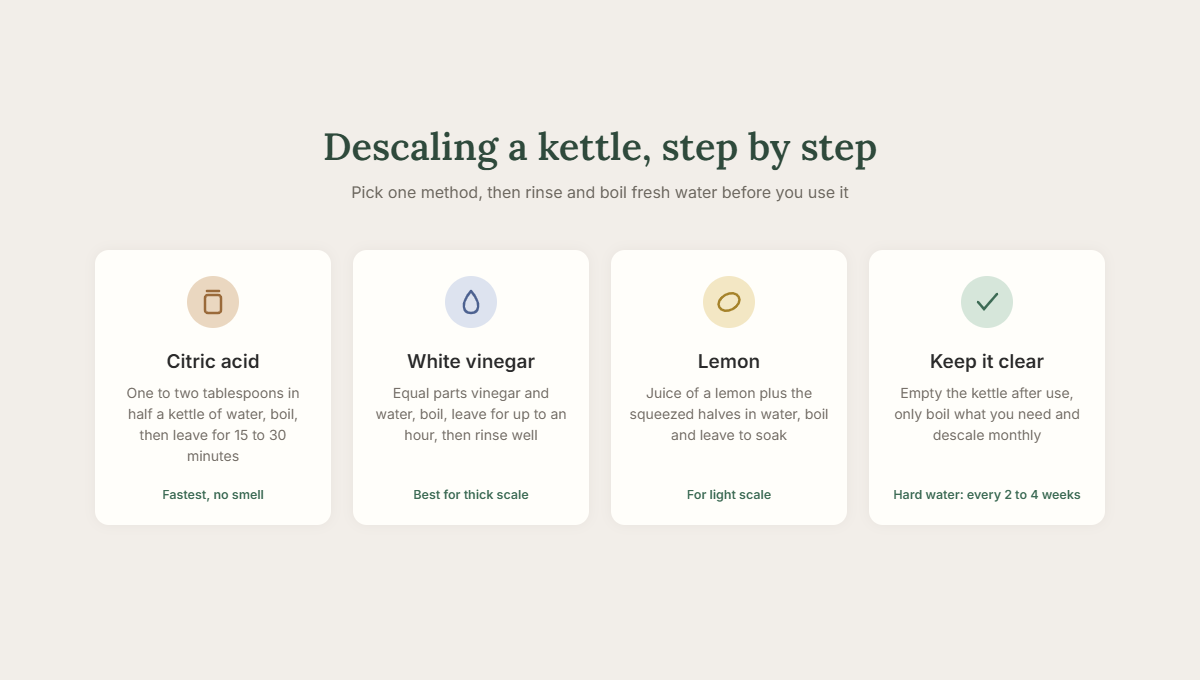
- Mix equal parts white vinegar and water. Fill the kettle until the scale is covered, usually about halfway.
- Bring it to the boil, then switch it off.
- Leave it to soak for 30 to 60 minutes. Open a window if the smell bothers you.
- Pour the solution away and rinse the kettle well.
- Fill with fresh water, boil, and throw that water away. Repeat once more.
For very thick scale, you may need a second round.
How to descale a kettle with citric acid
Citric acid is sold as a powder in supermarkets, baking aisles and hardware stores. It’s odorless, cheap per use, and very effective.
- Half-fill the kettle with water.
- Add 1 to 2 tablespoons of citric acid.
- Boil, then leave to stand for 15 to 30 minutes. You’ll often see the scale fizz and lift.
- Empty, rinse, then boil and discard fresh water once or twice.
Because it leaves no smell, this is the easiest method to repeat every few weeks.
Using lemon juice
Lemon is the gentlest option. It works on light scale and leaves the kitchen smelling fresh.
- Squeeze the juice of one or two lemons into a half-full kettle, or add a few slices.
- Boil, then leave for about an hour.
- Empty, rinse, and boil fresh water once before use.
For heavier buildup, lemon may need two or three rounds. That’s when citric acid or a descaler saves time.
Using a commercial descaler
Shop-bought descalers are designed for the job and usually work fastest on stubborn scale. Always follow the label exactly, including dilution, contact time and rinsing.
Before you buy, check that the product suits your kettle’s material and that it’s meant for appliances used with drinking water. Rinse thoroughly afterward and boil fresh water at least twice before making a drink.
Safety tips before you descale a kettle
- Never mix products. Don’t combine vinegar or descaler with bleach, and don’t use bleach in a kettle at all.
- Unplug and cool down before you scrub, empty or rinse.
- Keep the base dry. Never put a cordless kettle’s base or a corded kettle’s plug near water.
- Check the manual. Some makers give specific descaling advice, or warn against certain products.
- Clean the filter. If your kettle has a removable mesh filter at the spout, soak it separately in the solution and rinse.
- Skip abrasive pads on glass or plastic kettles. A soft brush is enough once the scale has softened.
Verdict by situation
So which way should you descale a kettle? It depends on where you’re starting from.
| Your situation | Best choice | Why |
|---|---|---|
| Regular upkeep every few weeks | Citric acid | Fast, odorless, cheap per use |
| Light scale and you have lemons | Lemon juice | Gentle and pleasant smelling |
| Moderate scale, nothing else in the cupboard | White vinegar | Works well, just rinse thoroughly |
| Thick, crusty scale | Commercial descaler, or two rounds of citric acid | Strongest, quickest result |
| Glass kettle you want sparkling | Citric acid | Clears cloudiness without scratching |
| Sensitive to smells | Citric acid or lemon | Little or no lingering odor |
If you only keep one product, choose citric acid. It handles most situations well.
How often to descale a kettle
There’s no fixed rule, because it depends on your water. As a general guide:
- Hard water areas: about once a month, or as soon as you see flakes.
- Moderate water: every two to three months.
- Soft water: a few times a year may be enough.
Scale shows up elsewhere too. If you’re dealing with crusty taps or spray nozzles, our guide to removing limescale from taps and shower heads uses similar methods. Hard water also affects glass, so see how to remove hard water stains from a shower door.
Cleaning the outside while you’re at it
Once the inside is clear, give the outside a quick clean too. Unplug the kettle and let it cool fully first.
For stainless steel, wipe with a soft cloth dampened with warm, soapy water, then buff dry in the direction of the grain. For plastic and glass, the same soapy cloth works, and a little diluted vinegar on a cloth lifts water spots. A paste of baking soda and water on a soft cloth helps with sticky marks near the handle.
Avoid getting water into the switch, the electrical connector or the base. Dry everything well before you plug it back in.
Keeping limescale away
A few habits slow the buildup between cleans:
- Boil only the water you need.
- Empty the kettle after use rather than leaving water standing.
- Rinse it out every few days.
- Consider a water filter jug if your area has very hard water.
- Wipe the outside regularly so mineral marks don’t bake on.
Frequently asked questions
Can I use baking soda to descale a kettle?
Baking soda sits on the alkaline side, which makes it poor at breaking down mineral scale. It’s better for cleaning stains on the outside. For scale inside, an acid such as citric acid or vinegar works far better.
Is limescale in a kettle harmful?
It’s generally seen as a cosmetic problem rather than a health one, but nobody wants flakes in their tea. Descaling also helps keep the element working efficiently.
Why does my tea taste of vinegar after descaling?
The kettle wasn’t rinsed enough. Rinse well, then boil and discard fresh water two or three more times.
Will descaling damage my kettle?
Not if you use a mild acid, follow the times above and rinse well. Always check the maker’s instructions, especially for specialty or vintage kettles.