How to Remove Limescale From Taps and Shower Heads
A quick answer, then step-by-step methods to remove limescale from taps and shower heads safely, with tips on finishes and prevention.
You can remove limescale from taps and shower heads with a mild acid, usually white vinegar or citric acid, a cloth, and a bit of patience. No harsh scrubbing needed. The acid dissolves the chalky mineral crust so it wipes away.
Here’s the short version first. The full method for each fixture follows.
Quick answer
Soak a cloth in white vinegar or a citric acid solution, wrap it around the limescale, and leave it for 30 to 60 minutes. For a shower head, tie a bag of the same solution over it. Then scrub gently with an old toothbrush, rinse with clean water, and dry. Check your tap finish first, because some coatings and natural stone can be damaged by acids.
What limescale actually is
Limescale is mostly calcium carbonate. It forms when hard water evaporates and leaves its dissolved minerals behind. That’s why it builds up wherever water sits and dries: around tap bases, on spouts, and inside shower head nozzles.
The U.S. Geological Survey explains what makes water hard and how calcium and magnesium end up in your supply. The harder your water, the faster it appears.
Left alone, the crust also traps soap scum and grime, which makes it harder to shift over time. On a shower head, it slowly narrows each nozzle until the spray turns weak and patchy. So it pays to deal with it early, while the layer is still thin.
Before you remove limescale: check the finish
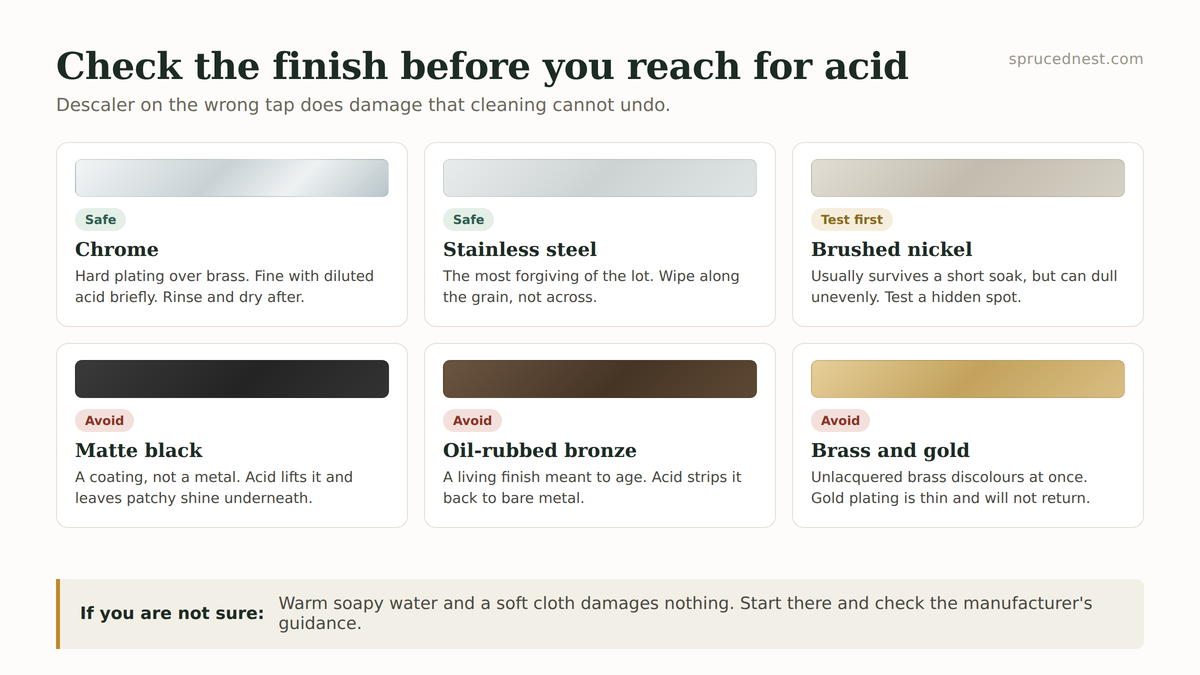
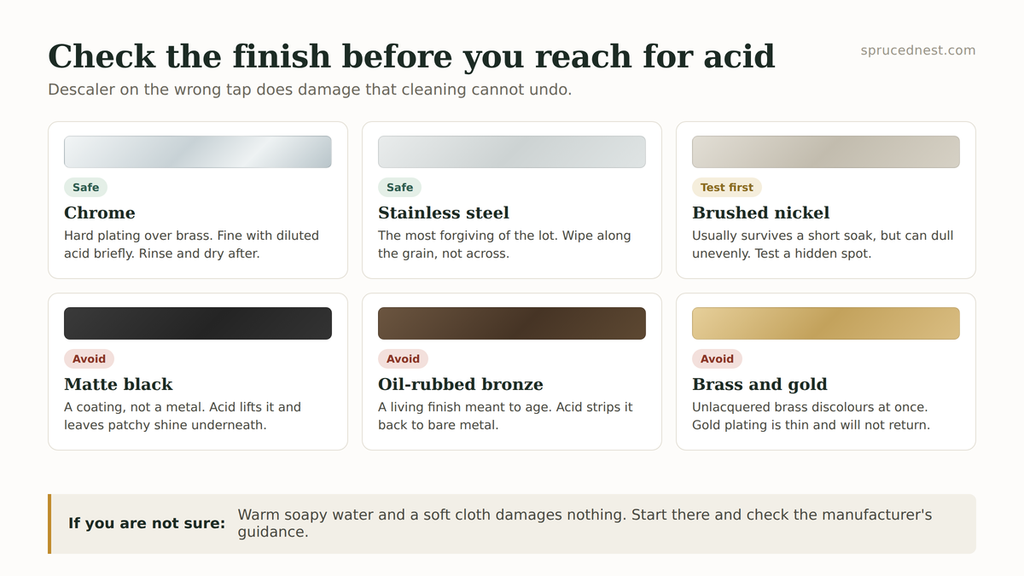
Acids are effective, but not every finish can take them. Standard chrome is usually fine with diluted vinegar for a short time. Other finishes need more care.
- Polished chrome: generally safe with diluted vinegar or citric acid. Rinse well.
- Brushed nickel, matte black, gold or brass-effect: check the manufacturer’s care guide first. Many advise against acids.
- Natural stone around the tap: keep acid off marble, limestone and travertine. It can etch the surface.
- Plastic shower heads: usually fine, but don’t leave them in strong solutions overnight.
When in doubt, test on a hidden spot. Or use a milder solution and a shorter contact time.
How to remove limescale from taps
What you need to remove limescale from taps
- White vinegar or citric acid powder
- Paper towels or a soft cloth
- A rubber band or two
- An old toothbrush
- A microfiber cloth for drying
Step 1: Mix your solution
For vinegar, use it neat for heavy buildup or half and half with water for lighter deposits. For citric acid, dissolve a tablespoon or two in a cup of warm water. Follow the packet if it gives a ratio.
Step 2: Wrap the problem areas
Soak paper towels or a cloth in the solution. Then wrap it tightly around the spout, the base of the tap, and any crusty joints. Secure it with a rubber band so it stays in contact.
Step 3: Wait
Leave it for 30 minutes to an hour. Thicker crusts may need longer, but check the finish every so often. Don’t leave acid on delicate finishes for extended periods.
Step 4: Scrub gently
Remove the wrap and scrub with an old toothbrush. Pay attention to the area where the tap meets the sink, and around handles. For the spout tip, unscrew the aerator if it comes off easily and soak it separately.
Step 5: Rinse and dry
Rinse everything well with clean water. Then dry and buff with a microfiber cloth. Drying is the step most people skip, yet it’s what stops new water spots forming straight away.
How to remove limescale from shower heads
Shower heads are trickier when you need to remove limescale, because the limescale sits inside the nozzles. As a result, water sprays unevenly or in thin, stinging jets.
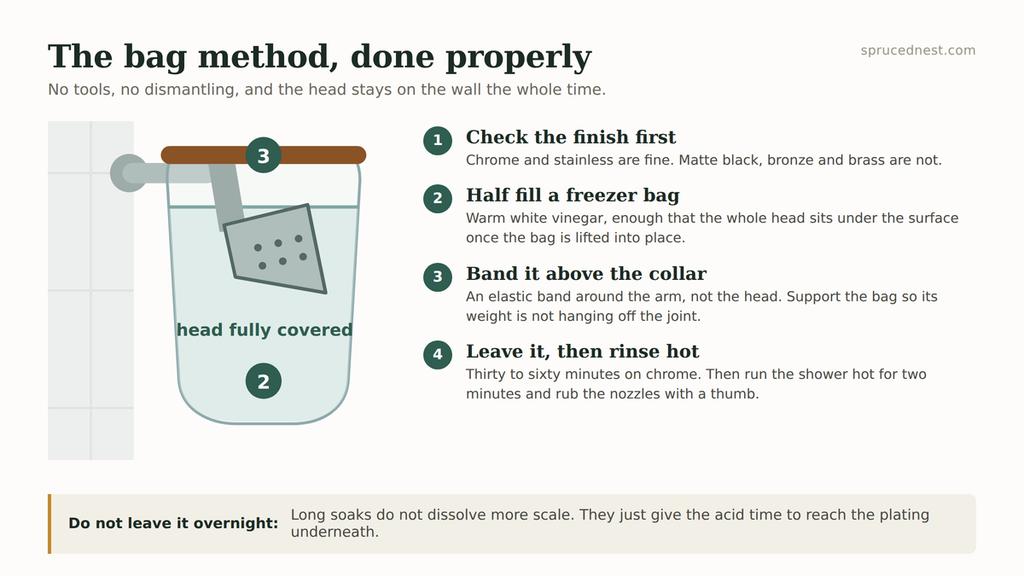
The bag method (no removal needed)
- Fill a plastic food bag about halfway with white vinegar or citric acid solution.
- Pull it up over the shower head so the face is fully submerged.
- Tie it in place with a rubber band or string around the arm.
- Leave it for an hour, or a little longer for heavy buildup.
- Remove the bag and run hot water through the head for a minute.
- Brush the face with a toothbrush. If the nozzles are soft rubber, flex each one gently with a fingertip to free any loosened grit.
This method is ideal if the shower head is fixed or you don’t want to unscrew anything.
The soak method (for removable heads)
If the head unscrews or detaches from a hose, soak it in a bowl of the solution instead. That way the whole thing, including the inside, gets treated.
After soaking, scrub, rinse, and run water through it before refitting. Check the washer or seal is still in place, so it doesn’t leak.
How to remove limescale from stubborn nozzles
Sometimes a few nozzles stay blocked. Gently poke them with a toothpick or a straightened paper clip, then rinse. Don’t use metal tools on the face, because they can scratch it.
Mistakes to avoid when you remove limescale
- Using abrasive pads. Scouring pads scratch chrome. Scratches then hold more water and minerals.
- Mixing cleaners. Never mix vinegar or other acids with bleach. The combination releases toxic chlorine gas.
- Leaving acid on too long. Overnight soaks can dull some finishes and damage seals.
- Forgetting the rinse. Leftover acid keeps working on the finish.
Commercial products that remove limescale
Vinegar and citric acid handle most jobs. Still, a store-bought bathroom descaling product can be useful for very thick, old crusts, or if you dislike the smell of vinegar.
Read the label closely. Many descaling products contain stronger acids than vinegar, so they work faster but carry more risk to finishes, grout and nearby stone. Wear gloves, keep the room ventilated, and follow the contact time exactly.
Also check whether the product is suitable for your fixture. Some are made for chrome only. Others are designed for toilets or kettles and shouldn’t go anywhere near a shower head. If a product doesn’t say it’s safe for your finish, use the gentler option instead.
How often to remove limescale
There’s no single schedule, because it depends on your water. In a soft water area, you may only need to deal with it every few months. In a hard water area, light buildup can return within a week or two.
A simple routine works for most homes:
- Weekly: wipe taps with a cloth dampened in diluted vinegar, then dry them.
- Monthly: do the bag method on the shower head, even if it looks clean.
- Every few months: unscrew and soak tap aerators.
Watch the spray pattern, too. If your shower starts spraying sideways or feels weaker, that’s a sign it’s time to remove limescale from the nozzles again, before it hardens further.
How to stop limescale coming back
Once you remove limescale, keeping it away is mostly about water not sitting on the surface.
- Dry taps after use. A quick wipe with a cloth takes seconds.
- Use a squeegee in the shower. It also helps with glass doors. Our guide to removing hard water stains from a shower door covers that in detail.
- Clean little and often. A weekly vinegar wipe stops buildup before it hardens.
- Consider a water softener. In very hard water areas, a softener reduces mineral levels for the whole house.
Limescale affects appliances too. If you’re dealing with a crusty kettle, see our guide on how to descale a kettle. And for the rest of the bathroom, here’s how to clean grout without damaging it.
Quick reference: the best way to remove limescale by fixture
| Fixture | Best method | Contact time |
|---|---|---|
| Chrome tap | Vinegar-soaked wrap | 30 to 60 minutes |
| Delicate tap finish | Manufacturer’s cleaner or mild soap | As directed |
| Fixed shower head | Bag method | About 1 hour |
| Removable shower head | Full soak | About 1 hour |
| Tap aerator | Soak in a small cup | 30 minutes |
Pick the method that matches your fixture, keep a cloth by the sink, and you’ll rarely need to do a big descaling job again.