How to Dry Clothes Indoors Without Making Your Home Damp
Most advice on how to dry clothes indoors is wrong. Here are 8 common myths, the facts behind them, and a simple routine that keeps damp and mold away.

You can dry clothes indoors all winter without a damp, musty home. The catch is that most of the advice passed around is wrong, and some of it makes the problem worse.
Wet laundry holds a lot of water. When it dries, that water doesn’t vanish. It moves into the air, then settles on the coldest surface it can find: windows, outside walls, the back of a wardrobe. Repeat that every few days and you get condensation, black spots and that stale smell nobody can quite place.
So, instead of another list of tips, let’s test the common beliefs one at a time. Each myth below is followed by what actually happens and what to do instead.

Why it matters how you dry clothes indoors
Moist air is the real issue, not the laundry itself. Warm air holds more water vapor than cold air. As soon as that air touches something cold, the vapor turns back into droplets.
That’s why the trouble shows up in corners, on window frames and behind furniture. These spots are cooler and get little air movement. Over time, they stay damp long enough for mold to grow.
The US Environmental Protection Agency puts it simply: control the moisture and you control the mold. Its guide to mold and moisture in the home recommends keeping indoor humidity below 60 percent, ideally between 30 and 50 percent.
Keep that target in mind as you read the myths.
8 myths about how to dry clothes indoors
Myth 1: A radiator is the best place to dry clothes indoors
Fact: It’s fast, but it pumps moisture straight into a warm room with nowhere to go.
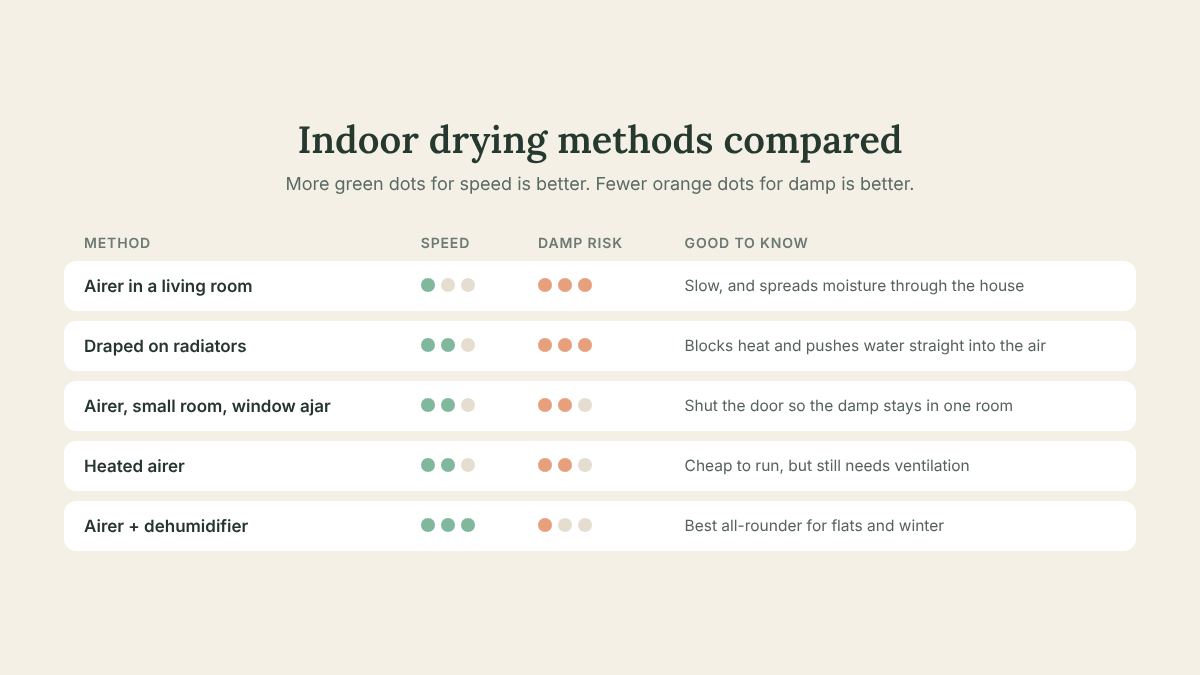
Laundry hung over a radiator also stops its warmth spreading out into the room. That leaves walls and windows colder, which is exactly where condensation forms. Thick items can dry stiff, and some fabrics can mark or shrink.
Do this instead: Put a clothes airer near the radiator, not on it. You still get the warmth, and the air can circulate around each item.
Myth 2: You must throw the windows wide open
Fact: A wide-open window in winter chills the room and slows drying. Cold clothes take longer to dry, so they release moisture for longer.
Ventilation does help, but a little goes a long way. A window open a few centimeters, or a trickle vent, lets damp air escape without wrecking the temperature.
Do this instead: Dry in one room, close the door to the rest of the house, and crack the window slightly. Alternatively, run the bathroom extractor fan with the airer set up in there.
Myth 3: Spreading the washing around the house helps
Fact: It spreads the moisture around the house too. Now every room is a little damp instead of one room being managed.
Do this instead: Choose a single small room. A spare bedroom, utility room or bathroom works well. Keep the door shut while the laundry dries so the moist air stays where you can deal with it.
Don’t pick the bedroom you sleep in if you can avoid it. You add your own breath to the moisture overnight.
Myth 4: Spin speed doesn’t matter when you dry clothes indoors
Fact: The spin cycle is the cheapest drying you’ll ever do. Every bit of water the machine removes is water that won’t end up on your walls.
Do this instead: Use the highest spin speed the care labels allow. For towels, jeans and bedding, an extra spin at the end of the cycle is worth the few minutes it takes.
Myth 5: A dehumidifier costs too much to run
Fact: A dehumidifier usually draws far less power than a heated tumble dryer. Check the wattage on the label to compare models, since running costs vary.
It also does two jobs at once. It speeds up drying and pulls moisture out of the room, rather than leaving it behind.
Do this instead: Set the dehumidifier up in the drying room with the door closed. Many models have a laundry mode. Empty the water tank after each load, and you’ll see how much water would otherwise have gone into your walls.
Myth 6: Packing the airer tightly gets more done
Fact: Overloaded airers dry slowly. Clothes touching each other trap moisture between them, and slow drying is what causes the sour smell.
Do this instead: Leave a small gap between items. Hang shirts on hangers from a door frame or rail. Turn thick items, such as hoodies, inside out and flip them halfway through.
Myth 7: A musty smell means you need more detergent
Fact: That smell usually comes from clothes that stayed damp too long. Extra detergent just leaves residue, which can make fabric hold odors.
Do this instead: Hang laundry the moment the cycle ends. Aim to have most loads dry within a day. If the smell lingers even on fresh washes, the machine itself may be the culprit, so check our guide to fixing washing machines that smell.
Myth 8: No visible mold means no damp problem
Fact: Mold is a late sign. Earlier warnings include water on the inside of windows each morning, a stuffy smell, and peeling paint near the ceiling.
Do this instead: Buy a cheap hygrometer and keep an eye on the reading while you dry clothes indoors. If it sits above 60 percent, add ventilation or a dehumidifier. For wet glass, our guide on how to stop condensation on windows covers the next steps.
Faster ways to dry clothes indoors: heated airers and dryers
A heated airer warms the clothes gently, so they dry faster than on a standard rack. However, the moisture still goes into the room. Pair it with a dehumidifier or an open window and a closed door.
A vented tumble dryer must have its hose leading outside. If the hose just dumps air into the room, you’ve moved the problem rather than solved it. Condenser and heat pump dryers collect the water in a tank or send it down a drain, so they don’t add humidity.
Either way, clean the lint filter after every load. A clogged filter slows drying and can become a fire risk.
How long should laundry take to dry?
In a closed room with a dehumidifier, most everyday loads dry within a day. Towels, jeans and bedding often take longer. Without any help, a cold room can leave clothes damp for two days or more.
That slow drying is the warning sign. The longer fabric stays wet, the more moisture escapes into your home and the more likely clothes are to smell. If loads regularly take more than a day, change one thing at a time. Try a faster spin, a smaller room or a dehumidifier, and see which makes the biggest difference.
Thin items, such as T-shirts and underwear, can go on the outer rails where air moves freely. Heavy pieces belong in the middle, closest to the warmth.
A simple routine to dry clothes indoors without damp
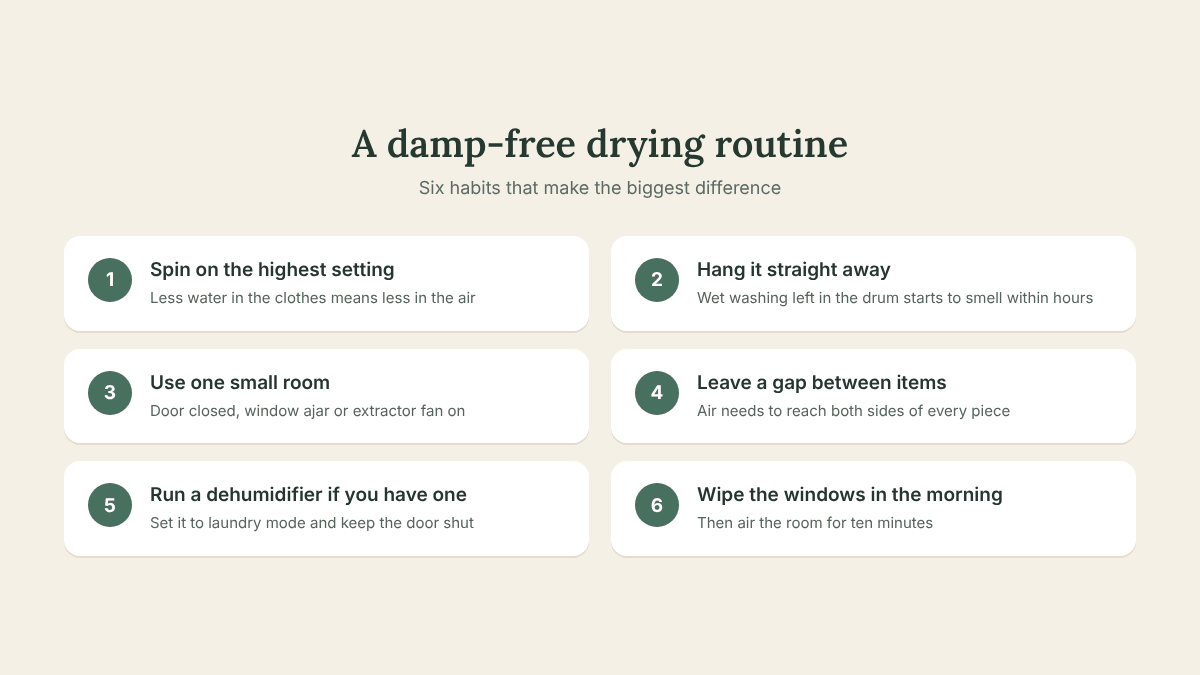
Use this order every time, and the habits soon become automatic.
- Spin the load on the fastest setting the labels allow.
- Unload it as soon as the cycle finishes.
- Shake each item out to loosen creases and fibers.
- Set up the airer in one small room, away from walls.
- Close the door and either crack a window or switch on the dehumidifier.
- Leave gaps between items and flip heavy pieces once.
- Wipe any water off the windows in the morning.
If you already have black spots on window seals or around the bath, deal with them early. Our guide to removing black mold from silicone sealant walks you through it safely.
Quick summary: myths vs facts
| Myth | What to do instead |
|---|---|
| Radiators are best | Use an airer near the heat, not on it |
| Open every window | Crack one window in a closed room |
| Spread laundry around | Keep it in one small room |
| Spin speed doesn’t matter | Use the highest safe spin |
| Dehumidifiers cost too much | Compare wattage; they often beat a dryer |
| Pack the airer tight | Leave gaps and flip thick items |
| More detergent fixes smells | Dry faster and clean the machine |
| No mold means no problem | Check humidity and window condensation |
The short version? Get less water into the air, keep the rest in one room, and give it a way out. Do that, and you can dry clothes indoors through the coldest months without the damp.